




Key findings:
The global AI in education market is projected to soar from $6.9B in 2025 to $41B by 2030, marking a sixfold growth in six years.
Solutions dominate the sector with 69.6% of market share, compared to 30.4% for services, highlighting strong demand for AI-powered learning tools.
83% of K-12 teachers already use generative AI, while only 22% of higher education faculty do so regularly, revealing a major adoption gap.
71% of teachers lack formal AI training, yet 83% actively use generative tools, showing rapid adoption outpacing preparedness.
ChatGPT leads student usage at 66%, followed by Grammarly and Microsoft Copilot at 25% each, illustrating how AI tools shape learning routines.
AI improves real-time feedback by 70% and boosts learning efficiency by 30%, confirming measurable gains in educational performance.
Despite these benefits, 25% of teachers believe AI does more harm than good, emphasizing the need for balanced integration and oversight.
Artificial intelligence (AI) is rapidly reshaping education, transforming how students learn, how teachers teach, and how institutions operate. From lesson planning and grading automation to personalized learning and real-time feedback, AI tools are becoming deeply embedded in classrooms and digital learning environments around the world.
In 2025, the global AI in education market stands at the threshold of exponential growth, projected to expand from $6.9 billion in 2025 to more than $41 billion by 2030. This growth reflects both technological innovation and changing priorities of educators, policymakers, and investors seeking more efficient, data-driven approaches to learning.
This report presents a comprehensive overview of key AI in education statistics for 2025, exploring global market trends, teacher and student adoption patterns, leading tools, and measurable learning outcomes. By analyzing these data-driven insights, we can better understand how AI is redefining the future of education, and what challenges and opportunities lie ahead for schools, universities, and learners worldwide.
Global AI in education market: size, growth, and trends
Global AI in Education Market Size and Growth: Key Statistics
The chart below illustrates the global AI in education market size from 2024 to 2030. Tracking these figures provides insight into the rapidly expanding role of AI technologies in educational systems worldwide. By examining these trends, we can better anticipate how investments and innovations are shaping the global education market.
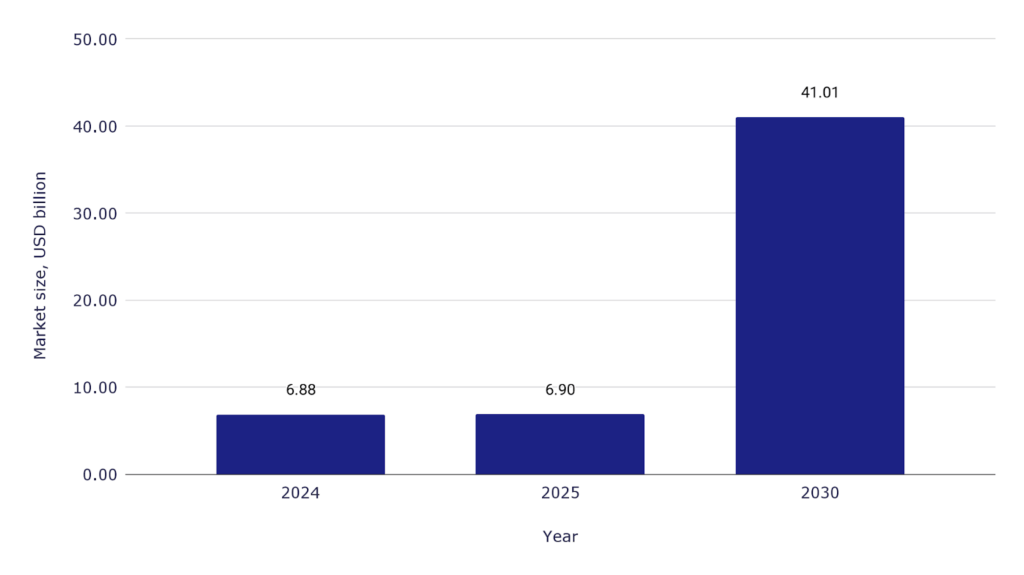
- The AI in education market size is projected to grow from USD 6.88 billion in 2024 to USD 6.90 billion in 2025.
- By 2030, the global AI in education market size is expected to reach USD 41.01 billion.
- This represents a more than sixfold increase in market size over six years, reflecting accelerating adoption of AI in education.
Global AI in Education: Market Trends and Forecasts
These AI in education statistics highlight the sector’s significant growth trajectory within the global education market. The relatively modest increase between 2024 and 2025 contrasts with the sharp rise expected by 2030, indicating both early-stage stability and long-term expansion. Understanding this trend is essential for educators, investors, and policymakers planning for the future of learning technologies.
After examining the overall market size, it’s important to understand how the AI in education market is divided between its core components.
Global AI in education: market composition by component
The chart illustrates the composition of the AI in education market in 2024, showing the relative share of solutions and services. These statistics about AI in education highlight how investments are concentrated, providing insight into which segments drive the global education market size.
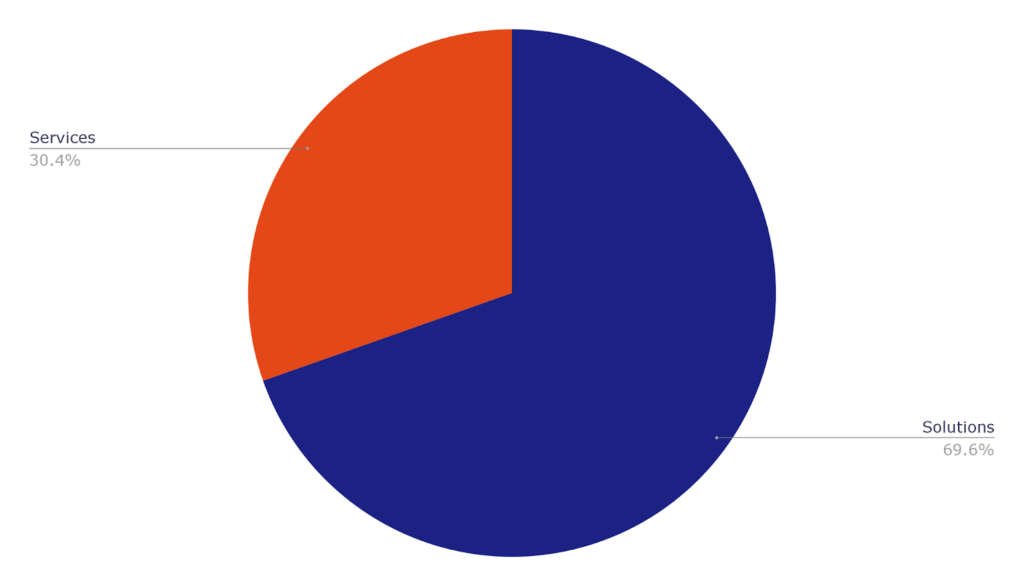
- Solutions account for 69.6% of the AI in education market in 2024.
- Services make up the remaining 30.4% of the market.
- The dominance of solutions underscores the focus on technological tools within the global education market.
Breakdown of AI in education statistics by component
The AI in education market composition reveals a clear preference for solutions over services, reflecting the strong demand for AI-powered learning tools. Understanding this breakdown is key for stakeholders looking to invest in or adopt AI technologies, as it shows where most of the market activity and growth are concentrated.
With the market size and component breakdown established, it’s essential to explore how AI adoption varies among educators.
How teachers are integrating AI in education: key statistics
Percentage of teachers using AI in education
The chart shows the percentage of teachers and education leaders using AI in 2024. It highlights the rate of AI integration in education across different groups, from K-12 teachers to higher education faculty and daily-use education leaders, providing a clear picture of adoption trends in the sector.
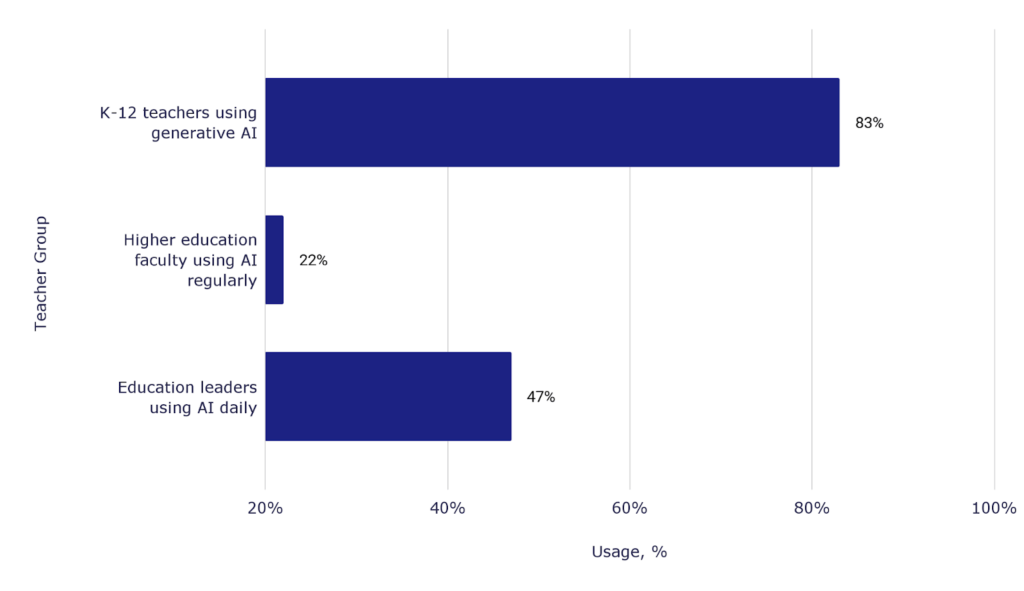
- 83% of K-12 teachers are using generative AI in their classrooms.
- Only 22% of higher education faculty report using AI regularly.
- 47% of education leaders use AI daily, reflecting leadership engagement in AI adoption.
AI Adoption in Education: Teacher and Leader Usage
These figures illustrate significant variation in the rate of AI integration in education, with K-12 teachers showing the highest adoption and higher education faculty the lowest. Education leaders’ daily usage indicates that strategic oversight is increasingly incorporating AI tools. Understanding these adoption patterns helps identify where AI is most actively shaping learning environments.
Having explored overall AI adoption among educators, it’s important to assess teacher readiness and current usage of AI tools in education.
Teacher readiness and AI usage in education
The chart presents key statistics on teacher readiness and the current use of AI in education. It highlights the percentage of teachers without formal AI training, those using generative AI tools, and institutions concerned about data security, providing a comprehensive view of adoption and preparedness.
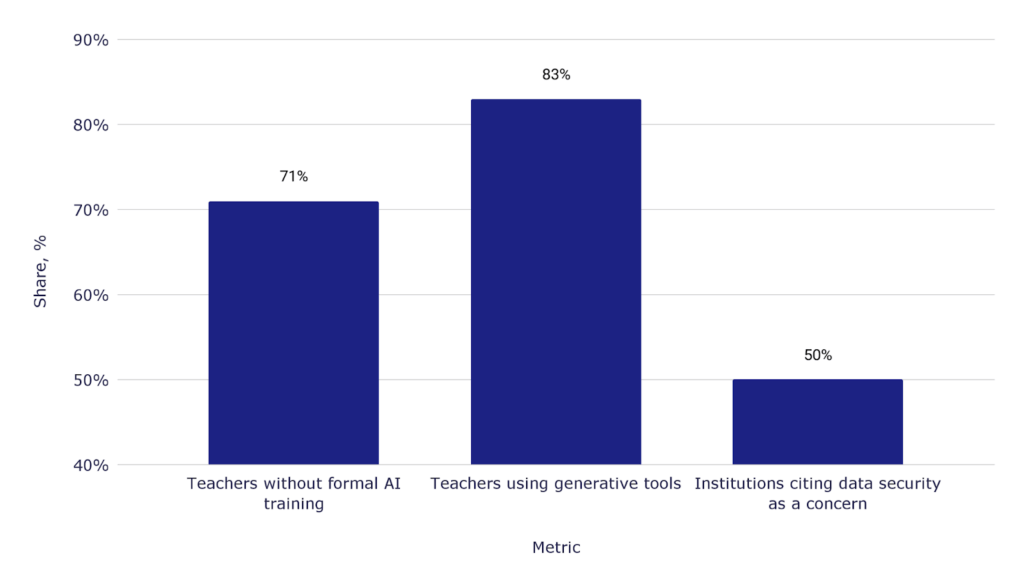
- 71% of teachers have not received formal AI training.
- 83% of teachers are actively using generative AI tools.
- 50% of educational institutions cite data security as a concern when integrating AI.
Key statistics on AI adoption and preparedness among teachers
These figures reveal a significant gap between teacher readiness and actual AI usage: while a majority lack formal training, a large proportion are already using generative tools. Data security concerns remain a critical issue for institutions, highlighting the need for comprehensive training and safeguards as AI adoption in education continues to grow.
After examining teacher readiness and current AI usage, it’s important to look at the specific applications of AI tools in educational settings.
Most common AI use cases among educators
The chart shows the most common AI use cases among educators, highlighting how AI tools are applied across teaching, assessment, administration, professional development, and student support. These statistics provide a detailed picture of the practical adoption of AI in education.
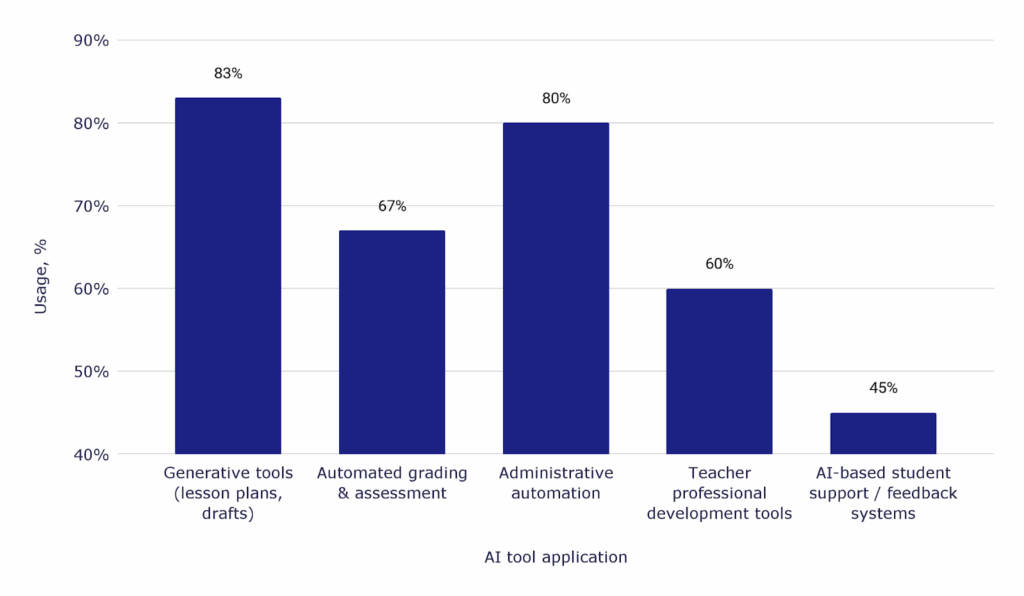
- 83% of teachers use generative tools for lesson plans and drafts.
- 80% of educators apply AI for administrative automation.
- 67% of teachers use AI for grading and assessment purposes.
How teachers are using AI: key applications
These figures illustrate that generative tools and administrative automation are the dominant AI applications among educators, followed closely by automated grading. AI-based professional development and student support systems are also gaining traction, reflecting a broad integration of AI technologies in educational processes. Understanding these use cases helps stakeholders identify where AI is delivering the most value in classrooms and institutions.
Having explored how educators are using AI, it’s equally important to understand how students are adopting these technologies in their learning activities.
Student AI usage: tools, trends, and learning applications
AI usage among students: key applications
The chart highlights how students use AI tools, showing the share of responses for different use cases such as searching for information, checking grammar, summarizing documents, paraphrasing, and creating first drafts. These insights answer key questions about how many students use AI and how it is integrated into everyday learning.
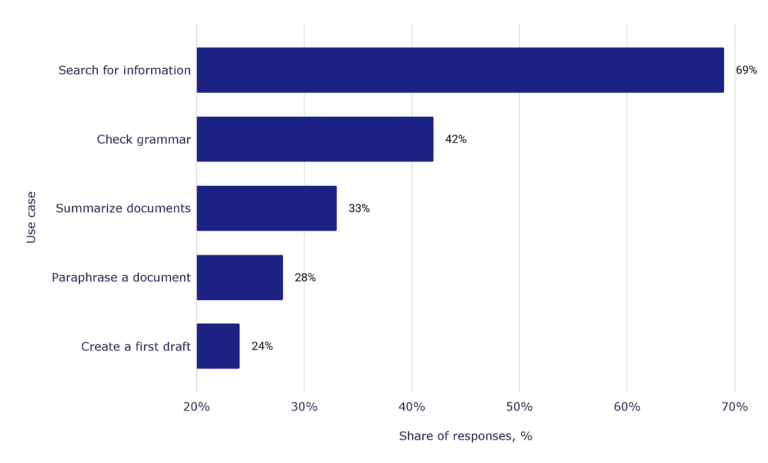
- 69% of students use AI to search for information.
- 42% of students use AI tools to check grammar.
- 33% of students use AI to summarize documents.
How many students use AI and for what purposes
The data illustrate that AI usage among students is predominantly focused on information retrieval and writing support. While fewer students use AI for drafting or paraphrasing, the overall adoption reflects a growing integration of AI tools into academic workflows. Understanding these use cases helps educators and policymakers assess the role of AI in enhancing learning outcomes.
Following the overview of how students use AI, it’s helpful to examine which specific AI tools are most popular among learners.
Most popular AI tools among students
The chart shows the most widely used AI tools among students, highlighting their primary functions. These statistics provide insights into which tools dominate academic workflows and support students’ learning and productivity.
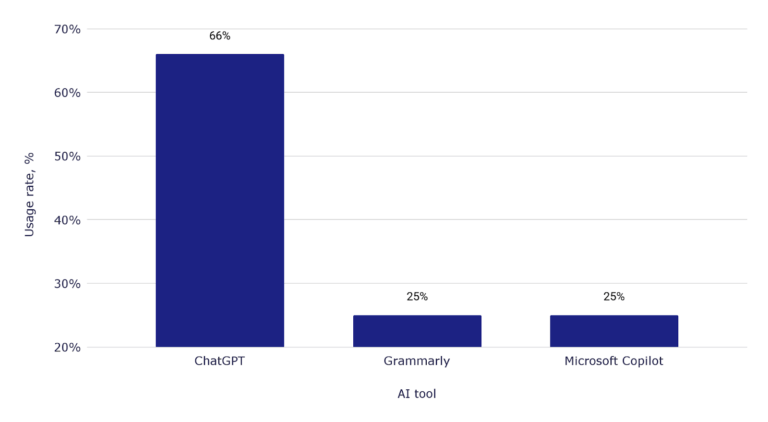
How many students use ChatGPT?
- 66% of students use ChatGPT, making it the most common overall tool.
How many students use AI to write essays?
- 25% of students use Grammarly for grammar and writing assistance.
- 25% of students use Microsoft Copilot for general assistance and productivity.
Top AI tools students use for learning
These figures reveal that ChatGPT leads AI adoption among students, primarily for general use and learning support. Grammarly and Microsoft Copilot are also widely used, focusing on writing assistance and productivity. Understanding tool preferences helps educators and institutions tailor guidance on effective AI usage in academic settings.
After examining tool usage and adoption, it is important to understand how students and educators perceive the benefits of AI across different countries.
Benefits of AI in education: tools, impact, and efficiency
Benefits of AI in education across countries
The chart highlights the percentage of respondents in various countries who view AI as beneficial in education. These benefits of AI in education statistics illustrate regional differences in adoption attitudes and perceived value, providing a global perspective on AI in learning environments.
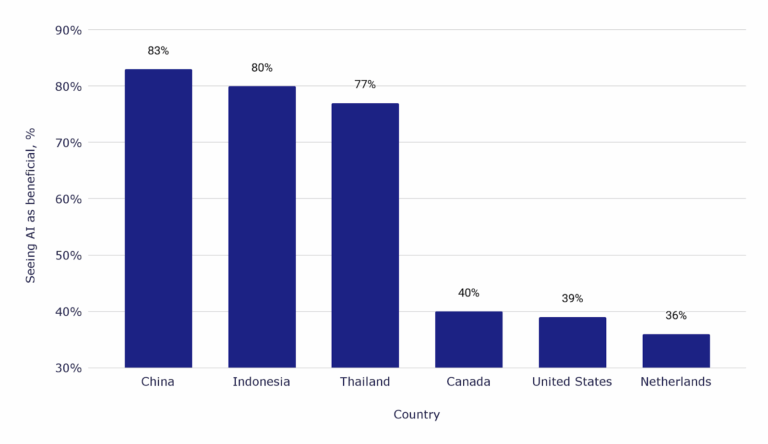
- 83% of respondents in China view AI as beneficial for education.
- 80% of respondents in Indonesia and 77% in Thailand perceive advantages from AI integration.
- Only 39% in the United States and 36% in the Netherlands consider AI beneficial in education.
Global AI in education statistics: perceived advantages
These figures indicate that perceptions of AI’s benefits in education vary widely by country, with higher acceptance in Asian countries and lower in North America and Europe. Understanding these differences is crucial for policymakers, educators, and technology providers aiming to implement AI learning tools effectively and address concerns highlighted in the negative effects of AI in education statistics.
Building on the benefits of AI observed across countries, it’s essential to examine its direct impact on student performance and learning efficiency.
AI impact on student performance and learning
The chart illustrates how AI affects student learning outcomes, including personalized learning, real-time feedback, and efficiency improvements. These benefits of AI in education statistics highlight measurable ways AI tools are enhancing learning experiences.
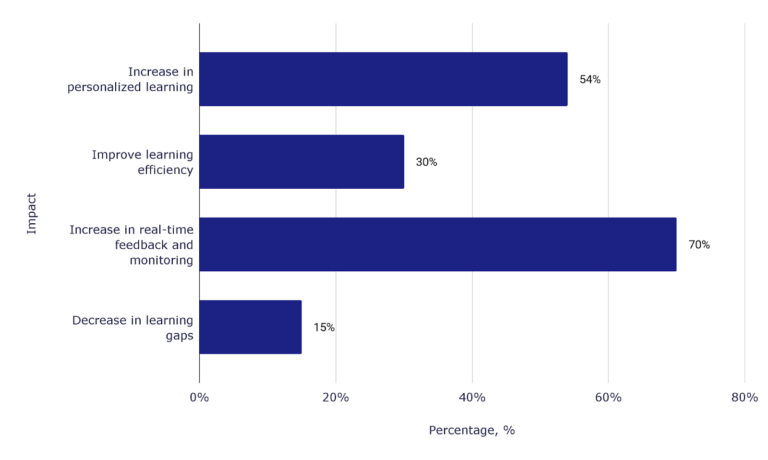
- Personalized learning increases by 54% with AI integration.
- Real-time feedback and monitoring improve learning outcomes by 70%.
- AI contributes to a 30% improvement in overall learning efficiency.
How AI improves learning outcomes: key statistics
These figures demonstrate that AI has a substantial positive impact on student performance, particularly through personalized learning and enhanced feedback mechanisms. While the decrease in learning gaps is smaller at 15%, the overall benefits of AI in education are clear, underscoring the value of adopting AI learning tools to improve educational outcomes.
After reviewing the positive effects of AI on student performance, it’s essential to consider the perspectives of both educators and students on potential negative impacts.
AI Impact on education: perceptions and concerns
The chart highlights perceptions of AI’s impact on education, showing the share of teachers who believe AI does more harm than good, those who see benefits, and students’ usage of AI tools like ChatGPT. These negative effects of AI in education statistics provide a balanced view of adoption challenges.
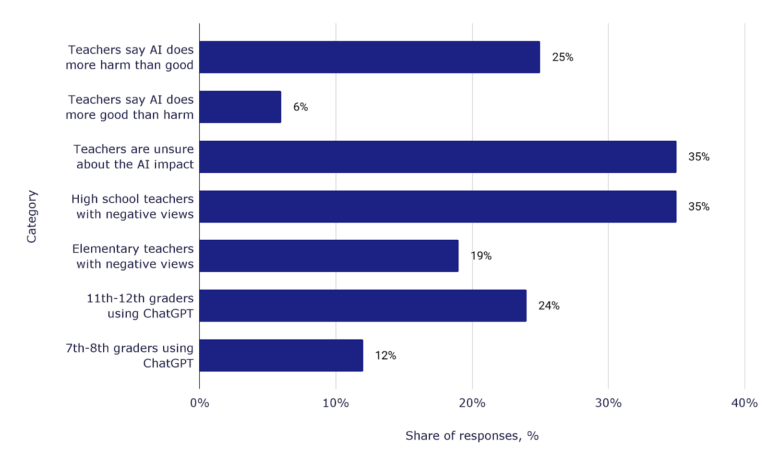
- 25% of teachers say AI does more harm than good.
- 35% of teachers are unsure about AI’s impact on education.
- 24% of 11th-12th graders report using ChatGPT in their learning.
Understanding the effects of AI in education
The data reveals mixed perceptions of AI in education, with a notable portion of teachers expressing concerns about potential harm, especially in high school settings (35%). While usage among older students is significant, uncertainties and negative views highlight the need for careful implementation and guidance. These statistics emphasize the importance of addressing both benefits and challenges in AI integration for learning environments.
Conclusions
By 2030, the global AI in education market is set to reach $41 billion, underscoring a structural transformation in how learning technologies are developed and adopted worldwide. The prevalence of AI-driven solutions (69.6%) shows that investment is shifting toward scalable digital tools rather than service-based models.
Adoption among K-12 educators is advancing rapidly, 83% already use generative AI, while higher education remains slower to adapt, reflecting differing institutional priorities and readiness levels. The lack of formal AI training for 71% of teachers, despite widespread use, points to a growing skills gap that could limit long-term benefits.
Students are emerging as key drivers of AI adoption, with 66% using ChatGPT and rising reliance on tools like Grammarly and Microsoft Copilot for learning support. This integration is reshaping study habits and expanding access to personalized learning assistance.
AI’s measurable impact, boosting learning efficiency by 30% and improving real-time feedback by 70%, demonstrates its potential to enhance educational outcomes. However, mixed perceptions among teachers, with one in four viewing AI as harmful, underline the need for thoughtful implementation, data protection, and ethical guidance as AI becomes integral to global education systems.
Sources
- “AI in Education Market Size, Trends & Growth | Industry Analysis, 2030.” Mordor Intelligence, 17 June 2025, https://www.mordorintelligence.com/industry-reports/ai-in-education-market. Accessed 10 November 2025.
- Edited by: Ángel De-Juanas, National. “Exploring the Effects of Artificial Intelligence on Student and Academic Well-Being in Higher Education: A Mini-Review – PMC.” NCBI Home Page, https://pmc.ncbi.nlm.nih.gov/articles/PMC11830699/. Accessed 11 Oct. 2025. Accessed 10 November 2025.
- Kelly, Rhea. “Survey: 86% of Students Already Use AI in Their Studies — Campus Technology.” Campus Technology, 28 Aug. 2024, https://campustechnology.com/Articles/2024/08/28/Survey-86-of-Students-Already-Use-AI-in-Their-Studies.aspx. Accessed 10 November 2025.
- Kumar, Naveen. “71 AI in Education Statistics 2025 – Global Trends.” DemandSage, 4 Nov. 2025, https://www.demandsage.com/ai-in-education-statistics/. Accessed 10 November 2025.
- User. “How Does AI Affect Education? Benefits & Challenges.” ESelf AI, 29 Apr. 2025, https://www.eself.ai/blog/how-ai-affects-education/. Accessed 10 November 2025.