




Key findings:
Total U.S. undergraduate enrollment declined from 18.08 million in 2010 to 16.56 million in 2019, indicating a long-term structural decrease that predated the COVID-19 pandemic.
Community college enrollment dropped sharply during the 2010s, falling from 7.22 million in 2010 to 5.40 million in 2019, while 4-year public institutions continued to grow.
COVID-19 accelerated declines, with community college undergraduate enrollment falling from 1.10 million in 2020 to 918,273 in 2023, resulting in a loss of approximately 177,727 students.
Undergraduate enrollment began recovering in 2024, with community colleges reaching 1,020,848 students by 2025, approaching pre-pandemic levels.
Vocational-focused community colleges experienced a steep decline in 2021-2022, followed by rapid growth in 2024-2025, reaching 870,585 students in 2025, reflecting strong increasing enrollment momentum.
Gender composition of undergraduates has remained stable, with women consistently representing around 57-58% of the student population before and after COVID-19.
Year-over-year changes show a clear transition from pandemic-related decline to recovery, suggesting that enrollment growth in community and vocational colleges is becoming structurally grounded rather than a temporary rebound.
Over the past decade, U.S. higher education has experienced significant shifts in student enrollment patterns, driven by both long-term trends and the disruptive impact of the COVID-19 pandemic. College enrollment decline has been a significant trend, with millions of students leaving postsecondary education between 2012 and 2022. At the same time, undergraduate enrollment trends reveal important variations across institution types, including four-year universities, community colleges, and vocational-focused programs.
Understanding these shifts is essential for policymakers, educators, and students alike. In this article, we explore how enrollment levels have changed over time, the demographic composition of undergraduates, and the recovery patterns observed in recent years. By examining community college enrollment, vocational college enrollment growth, and gender dynamics, we provide a comprehensive picture of U.S. undergraduate education before and after the pandemic.
Overall U.S. college enrollment decline: long-run trends and the pandemic shock
The chart illustrates total U.S. postsecondary enrollment over time, highlighting both long-term dynamics and the sharp disruption caused by the COVID-19 pandemic. It provides clear context for ongoing questions, such as whether college enrollment is declining and whether college enrollment is down, using historical enrollment levels to show how recent losses compare with past growth cycles.
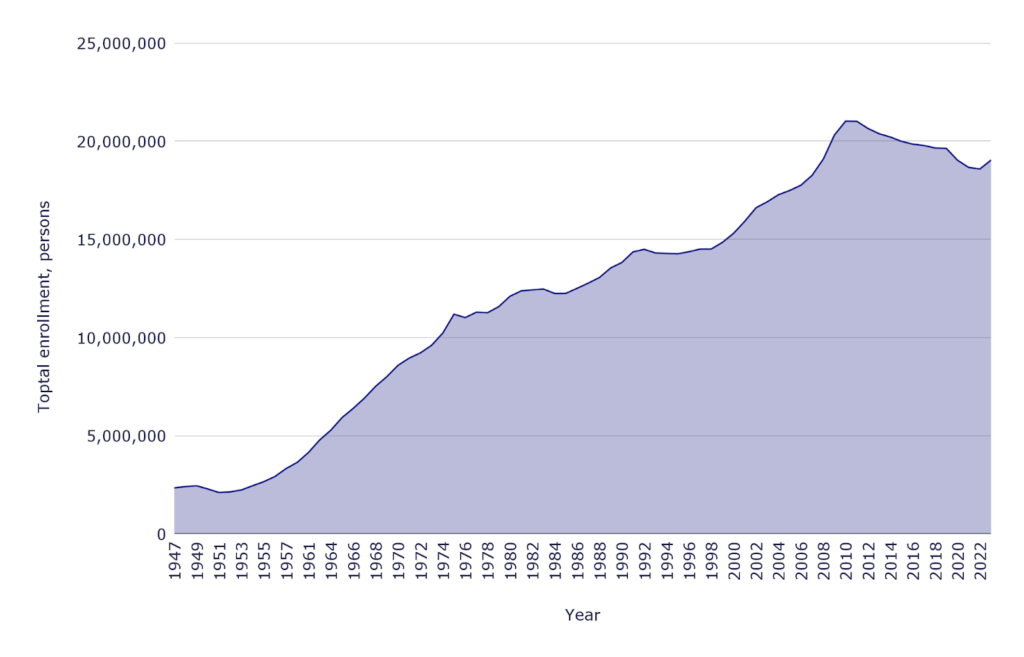
- From 2012 to 2022, total U.S. enrollment (including undergraduate and graduate students across all degree-granting institutions) fell from 20.6 million to 18.6 million students, confirming a sustained decline of roughly 2.1 million students over the decade. Note that undergraduate enrollment specifically, which excludes graduate students, exhibited slightly lower totals over the same period.
- Between fall 2019 and 2022, college enrollment declined from 19.63 million to 18.58 million students, a loss of about 1.05 million learners during the pandemic period.
- Although enrollment rebounded slightly in 2023 to 19.04 million students, levels remain well below the 2010 peak of 21.02 million, underscoring a long-term pattern of declining college enrollment.
College enrollment decline in the U.S.: a decade-long slide accelerated by COVID-19
| Year | Total enrollment, persons |
| 1947 | 2,338,226 |
| 1948 | 2,403,396 |
| 1949 | 2,444,900 |
| 1950 | 2,281,298 |
| 1951 | 2,101,962 |
| 1952 | 2,134,242 |
| 1953 | 2,231,054 |
| 1954 | 2,446,693 |
| 1955 | 2,653,034 |
| 1956 | 2,918,212 |
| 1957 | 3,323,783 |
| 1959 | 3,639,847 |
| 1961 | 4,145,065 |
| 1963 | 4,779,609 |
| 1964 | 5,280,020 |
| 1965 | 5,920,864 |
| 1966 | 6,389,872 |
| 1967 | 6,911,748 |
| 1968 | 7,513,091 |
| 1969 | 8,004,660 |
| 1970 | 8,580,887 |
| 1971 | 8,948,644 |
| 1972 | 9,214,860 |
| 1973 | 9,602,123 |
| 1974 | 10,223,729 |
| 1975 | 11,184,859 |
| 1976 | 11,012,137 |
| 1977 | 11,285,787 |
| 1978 | 11,260,092 |
| 1979 | 11,569,899 |
| 1980 | 12,096,895 |
| 1981 | 12,371,672 |
| 1982 | 12,425,780 |
| 1983 | 12,464,661 |
| 1984 | 12,241,940 |
| 1985 | 12,247,055 |
| 1986 | 12,503,511 |
| 1987 | 12,766,642 |
| 1988 | 13,055,337 |
| 1989 | 13,538,560 |
| 1990 | 13,818,637 |
| 1991 | 14,358,953 |
| 1992 | 14,487,359 |
| 1993 | 14,304,803 |
| 1994 | 14,278,790 |
| 1995 | 14,261,781 |
| 1996 | 14,367,520 |
| 1997 | 14,502,334 |
| 1998 | 14,506,967 |
| 1999 | 14,849,691 |
| 2000 | 15,312,289 |
| 2001 | 15,927,987 |
| 2002 | 16,611,711 |
| 2003 | 16,911,481 |
| 2004 | 17,272,044 |
| 2005 | 17,487,475 |
| 2006 | 17,754,230 |
| 2007 | 18,258,138 |
| 2008 | 19,081,686 |
| 2009 | 20,313,594 |
| 2010 | 21,019,438 |
| 2011 | 21,010,590 |
| 2012 | 20,644,478 |
| 2013 | 20,376,677 |
| 2014 | 20,209,092 |
| 2015 | 19,988,204 |
| 2016 | 19,846,904 |
| 2017 | 19,778,151 |
| 2018 | 19,651,412 |
| 2019 | 19,630,178 |
| 2020 | 19,027,410 |
| 2021 | 18,658,756 |
| 2022 | 18,583,497 |
| 2023 | 19,039,584 |
The data shows that college enrollment decline in the U.S. is not solely a pandemic-driven phenomenon but part of a longer downward trajectory that began after 2010. While COVID-19 intensified the drop, the broader decline in college enrollment reflects structural shifts that were already underway, including demographic changes and evolving postsecondary pathways. Overall, the trend confirms that college enrollment is now a persistent reality rather than a temporary disruption, even as short-term stabilization emerges after 2022.
After examining the overall college enrollment decline at the system-wide level, it is critical to isolate undergraduate enrollment to understand how the largest student segment was evolving before COVID-19.
Total undergraduate enrollment before COVID-19: growth, peak, and early decline
The chart tracks total undergraduate enrollment in the United States from 1970 through 2019, capturing long-term expansion followed by a gradual downturn. By visualizing changes in the undergraduate population over five decades, the data helps clarify what undergraduate enrollment and how the total number of undergraduate students shifted before the pandemic disruption.
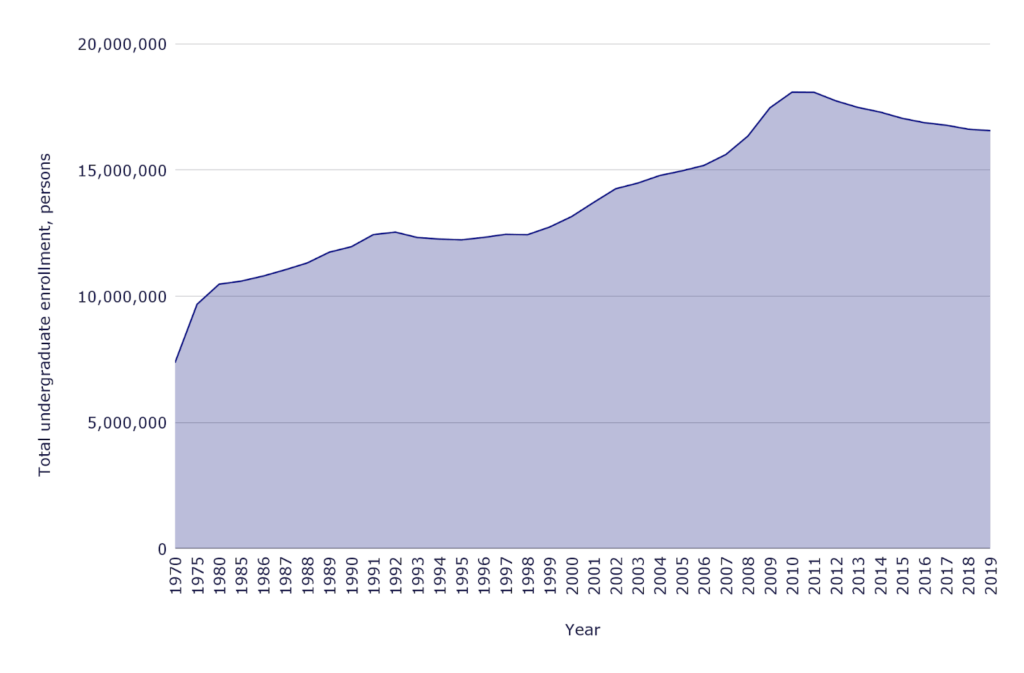
- Total undergraduate enrollment grew from 7.37 million students in 1970 to a peak of 18.08 million in 2010, reflecting nearly five decades of sustained expansion.
- Between 2010 and 2019, undergraduate enrollment declined from 18.08 million to 16.56 million students, a reduction of about 1.52 million before COVID-19.
- From 2012 to 2019 alone, the undergraduate population fell by roughly 1.18 million students, signaling that undergraduate enrollment was already trending downward years before the pandemic.
Undergraduate enrollment trends in the U.S. before the pandemic
| Year | Total undergraduate enrollment, persons |
| 1970 | 7,368,644 |
| 1975 | 9,679,455 |
| 1980 | 10,475,055 |
| 1985 | 10,596,674 |
| 1986 | 10,797,975 |
| 1987 | 11,046,235 |
| 1988 | 11,316,548 |
| 1989 | 11,742,531 |
| 1990 | 11,959,106 |
| 1991 | 12,439,287 |
| 1992 | 12,537,700 |
| 1993 | 12,323,959 |
| 1994 | 12,262,608 |
| 1995 | 12,231,719 |
| 1996 | 12,326,948 |
| 1997 | 12,450,587 |
| 1998 | 12,436,937 |
| 1999 | 12,739,445 |
| 2000 | 13,155,393 |
| 2001 | 13,715,610 |
| 2002 | 14,257,077 |
| 2003 | 14,480,364 |
| 2004 | 14,780,630 |
| 2005 | 14,963,964 |
| 2006 | 15,179,591 |
| 2007 | 15,613,540 |
| 2008 | 16,344,592 |
| 2009 | 17,464,179 |
| 2010 | 18,082,427 |
| 2011 | 18,077,303 |
| 2012 | 17,735,638 |
| 2013 | 17,476,304 |
| 2014 | 17,294,136 |
| 2015 | 17,046,673 |
| 2016 | 16,874,649 |
| 2017 | 16,773,036 |
| 2018 | 16,616,370 |
| 2019 | 16,557,539 |
The data shows that undergraduate enrollment reached its historical high around 2010 and entered a prolonged decline well before COVID-19 emerged. This sustained decrease in the total number of undergraduate students indicates that demographic and participation shifts were already reshaping the undergraduate student base. Overall, the pre-pandemic trend confirms that changes in undergraduate student enrollment are structural rather than temporary, setting the stage for the sharper declines observed after 2020.
After establishing the long-term trajectory of total undergraduate enrollment levels, the next step is to examine how year-over-year changes reveal the pace and consistency of shifts within the undergraduate population before COVID-19.
Total undergraduate enrollment changes before COVID-19: from expansion to persistent decline
The chart presents annual percentage changes in undergraduate enrollment, showing how the total undergraduate enrollment evolved from the late 1980s through 2019. By focusing on growth rates rather than absolute counts, the data clarifies how momentum within the undergraduate population gradually weakened over time, reshaping the total number of undergraduate students well before the pandemic.
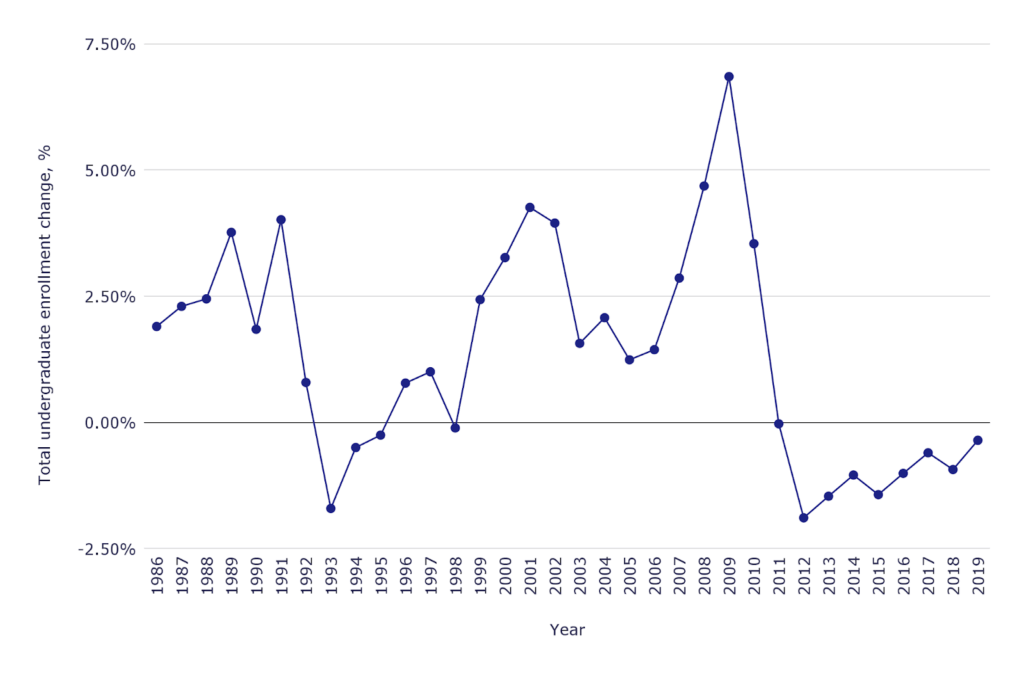
- Between 1986 and 2010, undergraduate enrollment recorded positive growth in 23 out of 25 years, peaking at +6.85% in 2009 during the post-recession surge.
- From 2012 through 2019, undergraduate enrollment declined every single year, with annual decreases ranging from -0.35% to -1.89%, indicating a prolonged contraction in undergraduate students.
- The shift from +3.54% growth in 2010 to -0.35% by 2019 highlights a structural reversal in undergraduate enrollment trends before COVID-19.
Undergraduate enrollment growth and contraction in the pre-pandemic era
| Year | Total undergraduate enrollment change, % |
| 1986 | 1.90% |
| 1987 | 2.30% |
| 1988 | 2.45% |
| 1989 | 3.76% |
| 1990 | 1.84% |
| 1991 | 4.02% |
| 1992 | 0.79% |
| 1993 | -1.70% |
| 1994 | -0.50% |
| 1995 | -0.25% |
| 1996 | 0.78% |
| 1997 | 1.00% |
| 1998 | -0.11% |
| 1999 | 2.43% |
| 2000 | 3.27% |
| 2001 | 4.26% |
| 2002 | 3.95% |
| 2003 | 1.57% |
| 2004 | 2.07% |
| 2005 | 1.24% |
| 2006 | 1.44% |
| 2007 | 2.86% |
| 2008 | 4.68% |
| 2009 | 6.85% |
| 2010 | 3.54% |
| 2011 | -0.03% |
| 2012 | -1.89% |
| 2013 | -1.46% |
| 2014 | -1.04% |
| 2015 | -1.43% |
| 2016 | -1.01% |
| 2017 | -0.60% |
| 2018 | -0.93% |
| 2019 | -0.35% |
The year-over-year data shows that undergraduate enrollment transitioned from cyclical growth to sustained decline well before the pandemic, answering what undergraduate enrollment is in practical, trend-based terms. Rather than a sudden shock, the contraction in the total number of undergraduate students reflects a slow erosion of growth that began after 2010 and intensified throughout the 2010s. Overall, the pre-pandemic pattern confirms that changes in total undergraduate enrollment were already embedded in the system, setting a weakened baseline for the undergraduate population entering the COVID-19 period.
After analyzing pre-pandemic enrollment dynamics, spring-term data provide a clearer view of how enrollment growth evolved during and after the COVID-19 disruption.
Spring enrollment growth by year: measuring the COVID-19 impact and recovery
The chart compares U.S. spring enrollment levels from 2020 through 2025, capturing the immediate pandemic decline and the subsequent recovery phase. By tracking year-over-year changes, the data addresses questions such as whether more people are going to college and whether the recent enrollment increase reflects a sustained shift or a short-term rebound.
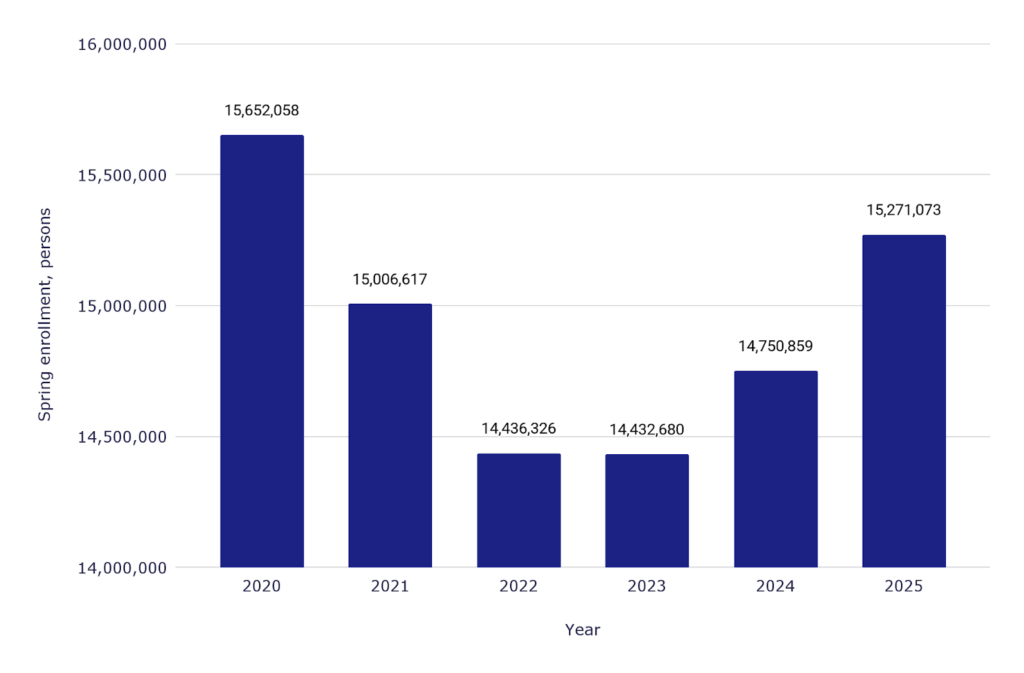
- Spring enrollment fell from 15.65 million students in 2020 to 14.44 million in 2022, a loss of approximately 1.22 million students during the peak COVID-19 period.
- Between spring 2023 and spring 2024, enrollment rose from 14.43 million to 14.75 million students, marking an increase of about 318,000 students year over year.
- Spring enrollment reached 15.27 million students in 2025, up roughly 520,000 students from 2024, representing the strongest post-pandemic enrollment growth in the series.
- Spring enrollment fell from 15.65 million students in 2020 to 14.44 million in 2022, a loss of approximately 1.22 million students during the peak COVID-19 period.
- Between spring 2023 and spring 2024, enrollment rose from 14.43 million to 14.75 million students, marking an increase of about 318,000 students year over year.
- Spring enrollment reached 15.27 million students in 2025, up roughly 520,000 students from 2024, representing the strongest post-pandemic enrollment growth in the series.
Enrollment increase in spring terms: post-pandemic signals from U.S. colleges
The spring enrollment trend shows a clear transition from pandemic-driven contraction to renewed enrollment growth beginning in 2024. While current levels remain below the 2020 baseline, the consistent enrollment increase across consecutive years suggests improving participation in higher education. Taken together, the data support cautious optimism around projected enrollment and near-term enrollment projections, indicating that the increase in college enrollment is becoming more structurally grounded rather than purely cyclical.
While absolute spring enrollment levels show the scale of recovery, examining year-over-year percent change reveals how quickly enrollment growth momentum has returned.
Spring enrollment percent change by year: COVID-19 decline and recovery
The chart presents annual percentage changes in spring enrollment, highlighting shifts in enrollment growth from the height of the pandemic through the recovery phase. By focusing on relative change, the data helps assess whether the recent enrollment increase signals that more people are going to college or reflects short-term normalization effects.
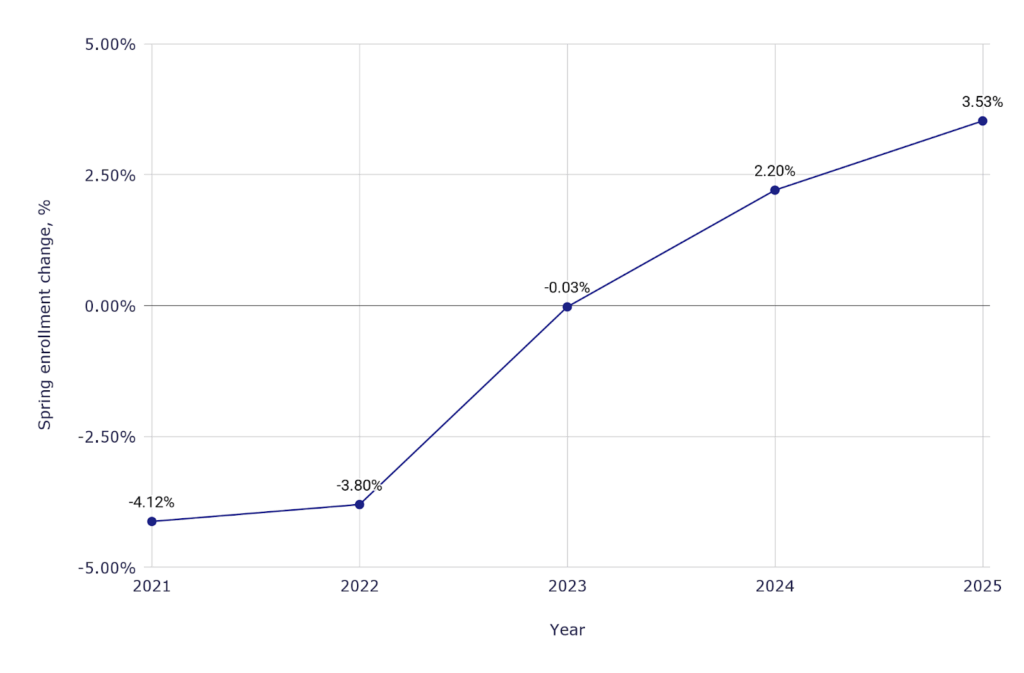
- Spring enrollment declined sharply in 2021 and 2022, with year-over-year decreases of -4.12% and -3.80%, marking the deepest pandemic-related contraction.
- In 2023, spring enrollment stabilized at -0.03%, effectively ending two consecutive years of steep decline.
- Enrollment growth turned positive in 2024 and accelerated in 2025, rising from +2.20% to +3.53%, indicating a strengthening increase in college enrollment.
Enrollment growth in spring terms: year-over-year percent change after COVID-19
The percent-change trend confirms a clear inflection point from contraction to enrollment growth beginning in 2024. After two years of significant losses, the transition to consecutive positive growth rates suggests that the recent enrollment increase is gaining traction rather than stalling at stabilization. Overall, these dynamics support cautiously positive enrollment projections and projected enrollment scenarios, indicating that spring-term participation is moving toward a more durable recovery phase.
After reviewing system-wide enrollment recovery patterns, a closer look at community college undergraduate enrollment reveals how public 2-year institutions have evolved relative to four-year colleges.
Community college undergraduate enrollment: long-term shifts in public 2-year institutions
The chart compares undergraduate enrollment across public 2-year and public 4-year institutions from 1970 through 2019, highlighting divergent long-term trajectories. By breaking out enrollment by institution type, the data provides concrete context for community college enrollment trends and broader community college enrollment statistics within the public higher education system.
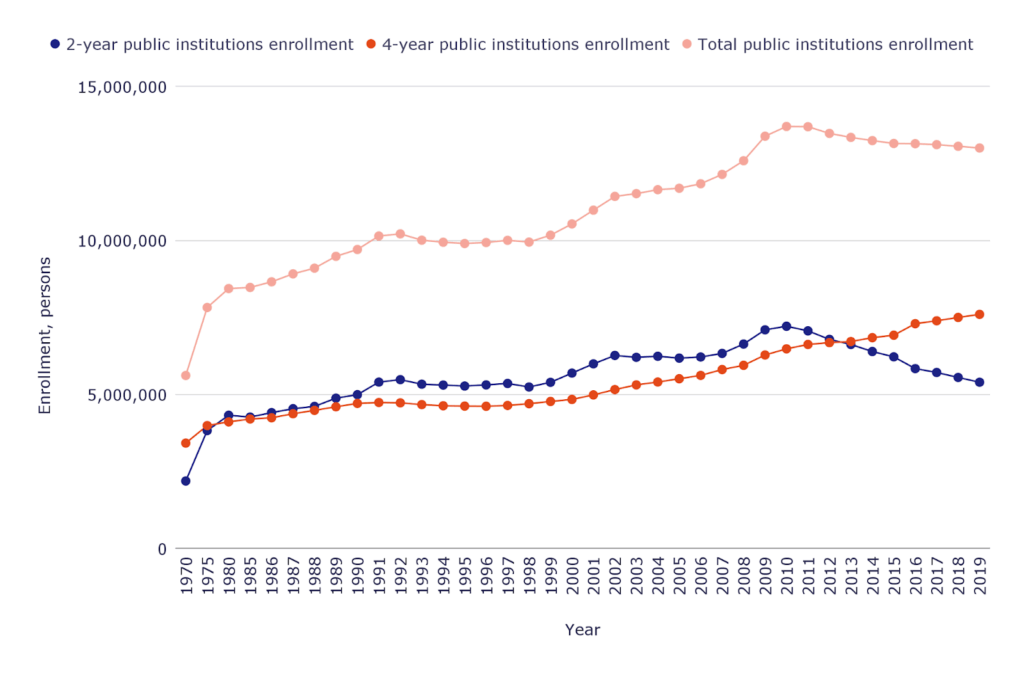
- Public 2-year institution enrollment (community college undergraduate enrollment) increased from 2.19 million students in 1970 to a peak of 7.22 million in 2010, before declining to 5.40 million by 2019. This figure reflects only undergraduate students attending public 2-year institutions and does not include students in 4-year colleges or graduate programs.
- Between 2010 and 2019, community college enrollment fell by approximately 1.82 million students, while public 4-year institutions grew from 6.48 million to 7.60 million over the same period.
- By 2019, public 4-year institutions enrolled about 7.60 million undergraduate students compared with 5.40 million in public 2-year institutions, reversing the balance seen in the early 1990s.
Community college enrollment trends in the U.S. undergraduate system
| Year | 2-year public institutions enrollment, persons | 4-year public institutions enrollment, persons | Total public institutions enrollment, persons |
| 1970 | 2,194,983 | 3,425,272 | 5,620,255 |
| 1975 | 3,831,973 | 3,994,059 | 7,826,032 |
| 1980 | 4,327,592 | 4,114,363 | 8,441,955 |
| 1985 | 4,269,733 | 4,207,392 | 8,477,125 |
| 1986 | 4,413,691 | 4,247,025 | 8,660,716 |
| 1987 | 4,541,054 | 4,377,535 | 8,918,589 |
| 1988 | 4,615,487 | 4,487,659 | 9,103,146 |
| 1989 | 4,883,660 | 4,604,082 | 9,487,742 |
| 1990 | 4,996,475 | 4,713,121 | 9,709,596 |
| 1991 | 5,404,815 | 4,743,142 | 10,147,957 |
| 1992 | 5,484,514 | 4,731,783 | 10,216,297 |
| 1993 | 5,337,022 | 4,674,765 | 10,011,787 |
| 1994 | 5,308,366 | 4,636,762 | 9,945,128 |
| 1995 | 5,277,398 | 4,626,228 | 9,903,626 |
| 1996 | 5,314,038 | 4,621,245 | 9,935,283 |
| 1997 | 5,360,686 | 4,646,793 | 10,007,479 |
| 1998 | 5,245,963 | 4,704,249 | 9,950,212 |
| 1999 | 5,397,786 | 4,776,442 | 10,174,228 |
| 2000 | 5,697,061 | 4,842,261 | 10,539,322 |
| 2001 | 5,996,651 | 4,989,220 | 10,985,871 |
| 2002 | 6,270,199 | 5,162,656 | 11,432,855 |
| 2003 | 6,208,885 | 5,314,218 | 11,523,103 |
| 2004 | 6,243,344 | 5,407,236 | 11,650,580 |
| 2005 | 6,184,000 | 5,513,730 | 11,697,730 |
| 2006 | 6,219,880 | 5,622,745 | 11,842,625 |
| 2007 | 6,335,826 | 5,811,918 | 12,147,744 |
| 2008 | 6,639,928 | 5,950,019 | 12,589,947 |
| 2009 | 7,101,569 | 6,284,806 | 13,386,375 |
| 2010 | 7,218,063 | 6,484,937 | 13,703,000 |
| 2011 | 7,068,158 | 6,626,741 | 13,694,899 |
| 2012 | 6,792,065 | 6,686,035 | 13,478,100 |
| 2013 | 6,626,411 | 6,721,881 | 13,348,292 |
| 2014 | 6,397,552 | 6,846,981 | 13,244,533 |
| 2015 | 6,224,304 | 6,926,519 | 13,150,823 |
| 2016 | 5,842,909 | 7,301,070 | 13,143,979 |
| 2017 | 5,717,460 | 7,395,134 | 13,112,594 |
| 2018 | 5,556,085 | 7,503,675 | 13,059,760 |
| 2019 | 5,400,865 | 7,603,278 | 13,004,143 |
The data show that community college undergraduate enrollment expanded rapidly through the late 2000s before entering a prolonged contraction during the 2010s. While overall public institution enrollment remained relatively stable, growth shifted decisively toward four-year colleges, reshaping how many students attend community colleges within the undergraduate population. Taken together, these community college enrollment statistics, alongside related trade school enrollment trends and trade school enrollment statistics, suggest a structural reallocation of undergraduate students rather than a uniform system-wide decline.
While absolute enrollment levels show how community colleges have shrunk over time, year-over-year change highlights when and how consistently this contraction unfolded.
Community college undergraduate enrollment change year-over-year: diverging paths within public higher education
The chart displays annual percentage changes in undergraduate enrollment across public 2-year and public 4-year institutions from 1986 to 2019. By comparing growth rates across institution types, the data sharpens community college enrollment trends and places community college enrollment statistics in contrast with broader public higher education dynamics.
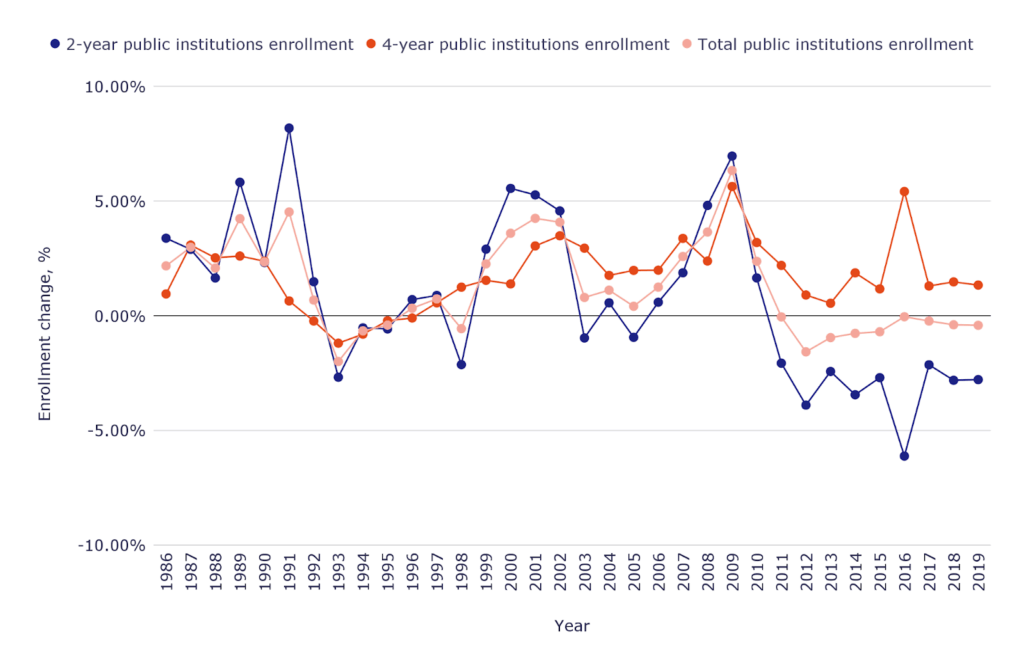
- Public 2-year institutions recorded strong growth in the late 1980s and early 1990s, peaking at +8.17% year-over-year in 1991, far outpacing public 4-year growth of +0.64% that year.
- From 2011 through 2019, community college enrollment declined every single year, with annual decreases ranging from -2.08% to -6.13%, indicating a prolonged structural contraction.
- In contrast, public 4-year institutions posted positive year-over-year growth in all but one year between 2011 and 2019, widening the enrollment gap within total public institutions.
Community college enrollment trends: year-over-year declines before COVID-19
| Year | 2-year public institutions enrollment, % | 4-year public institutions enrollment, % | Total public institutions enrollment, % |
| 1986 | 3.37% | 0.94% | 2.17% |
| 1987 | 2.89% | 3.07% | 2.98% |
| 1988 | 1.64% | 2.52% | 2.07% |
| 1989 | 5.81% | 2.59% | 4.22% |
| 1990 | 2.31% | 2.37% | 2.34% |
| 1991 | 8.17% | 0.64% | 4.51% |
| 1992 | 1.47% | -0.24% | 0.67% |
| 1993 | -2.69% | -1.21% | -2.00% |
| 1994 | -0.54% | -0.81% | -0.67% |
| 1995 | -0.58% | -0.23% | -0.42% |
| 1996 | 0.69% | -0.11% | 0.32% |
| 1997 | 0.88% | 0.55% | 0.73% |
| 1998 | -2.14% | 1.24% | -0.57% |
| 1999 | 2.89% | 1.53% | 2.25% |
| 2000 | 5.54% | 1.38% | 3.59% |
| 2001 | 5.26% | 3.03% | 4.24% |
| 2002 | 4.56% | 3.48% | 4.07% |
| 2003 | -0.98% | 2.94% | 0.79% |
| 2004 | 0.55% | 1.75% | 1.11% |
| 2005 | -0.95% | 1.97% | 0.40% |
| 2006 | 0.58% | 1.98% | 1.24% |
| 2007 | 1.86% | 3.36% | 2.58% |
| 2008 | 4.80% | 2.38% | 3.64% |
| 2009 | 6.95% | 5.63% | 6.33% |
| 2010 | 1.64% | 3.18% | 2.37% |
| 2011 | -2.08% | 2.19% | -0.06% |
| 2012 | -3.91% | 0.89% | -1.58% |
| 2013 | -2.44% | 0.54% | -0.96% |
| 2014 | -3.45% | 1.86% | -0.78% |
| 2015 | -2.71% | 1.16% | -0.71% |
| 2016 | -6.13% | 5.41% | -0.05% |
| 2017 | -2.15% | 1.29% | -0.24% |
| 2018 | -2.82% | 1.47% | -0.40% |
| 2019 | -2.79% | 1.33% | -0.43% |
The year-over-year data confirms that community college undergraduate enrollment entered sustained decline well before the pandemic, even as four-year public institutions continued to grow. This divergence reshaped how many students attend community colleges, shifting undergraduate participation away from the 2-year sector over the 2010s. Overall, these community college enrollment statistics, alongside related trade school enrollment trends and trade school enrollment statistics, point to a long-term reallocation of students rather than a temporary cyclical downturn.
After examining pre-pandemic declines in community college enrollment, it is important to assess how the sector has recovered in the years following COVID-19.
Community college undergraduate enrollment after COVID-19: early recovery trends
The chart tracks total undergraduate enrollment in public 2-year institutions from 2020 through 2025, illustrating both the immediate post-pandemic decline and early signs of recovery. By visualizing these shifts, the data highlights community college enrollment trends and provides insight into how many students attend community colleges in the post-pandemic period.
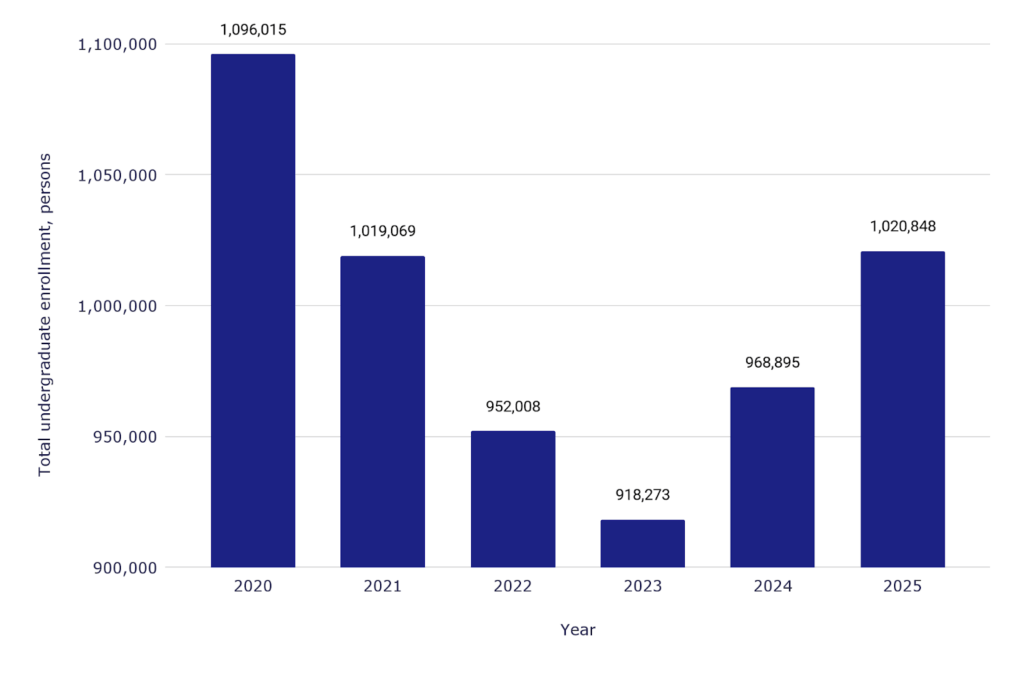
- Community college undergraduate enrollment (students enrolled in public 2-year institutions) dropped from 1,096,015 students in 2020 to 918,273 in 2023, a decline of approximately 177,742 students following the pandemic. Note that this count excludes graduate students and students in 4-year institutions.
- Enrollment began recovering in 2024, rising to 968,895 students, an increase of about 50,622 year-over-year.
- By 2025, community college undergraduate enrollment reached 1,020,848 students, approaching pre-pandemic levels and showing a measurable recovery.
Post-pandemic community college enrollment: changes in undergraduate population
The data shows that COVID-19 caused a significant decline in community college undergraduate enrollment, with the lowest point in 2023. However, subsequent growth in 2024 and 2025 indicates that community college enrollment trends are stabilizing and the undergraduate population is recovering. Overall, the post-pandemic trajectory suggests that the sector is gradually regaining students, reflecting early recovery patterns rather than a permanent contraction.
While absolute enrollment levels illustrate the scale of the post-pandemic decline, examining year-over-year changes reveals the pace of recovery in community colleges.
Community college undergraduate enrollment change after COVID-19: recovery in motion
The chart presents annual percentage changes in community college undergraduate enrollment from 2021 through 2025. By highlighting growth and contraction, the data helps interpret community college enrollment trends and shows how the undergraduate population is adjusting after the disruptions caused by COVID-19.
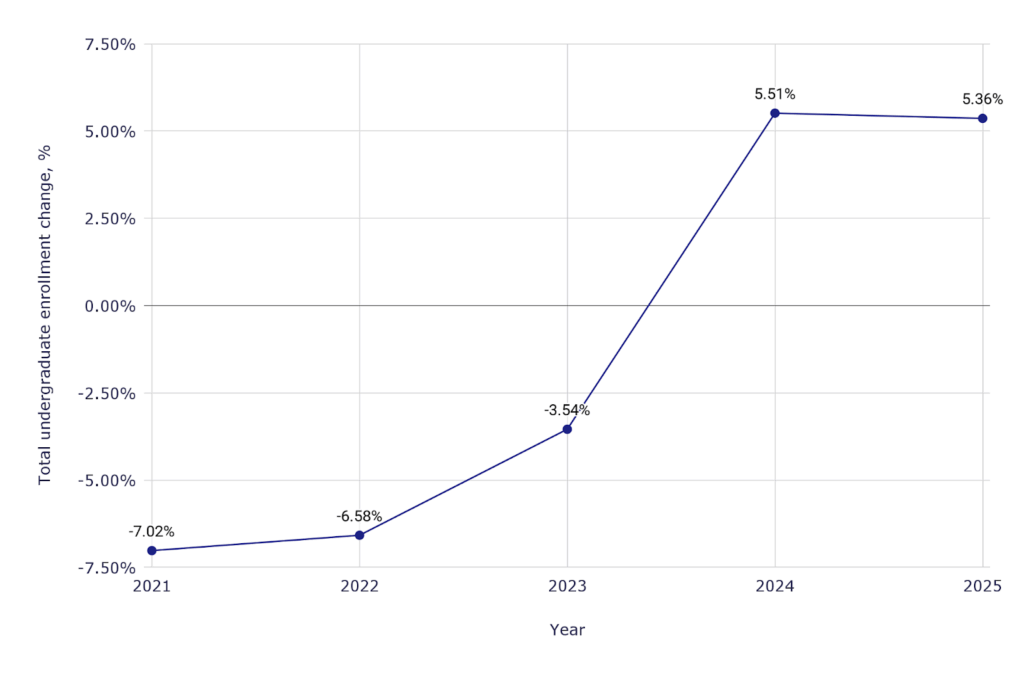
- Community college enrollment fell sharply in 2021 and 2022, with year-over-year decreases of -7.02% and -6.58%, reflecting the most severe post-pandemic impact.
- The decline slowed in 2023 to -3.54%, indicating that enrollment losses were beginning to stabilize.
- Enrollment rebounded strongly in 2024 and 2025, rising by +5.51% and +5.36% respectively, signaling a rapid recovery in undergraduate students.
Year-over-year enrollment growth in community colleges post-pandemic
The year-over-year percentage changes confirm that COVID-19 caused substantial declines in community college enrollment, with the largest drops occurring in 2021 and 2022. Subsequent growth in 2024 and 2025 suggests a resilient rebound, with the undergraduate population approaching pre-pandemic levels. Overall, the data indicate that community college enrollment trends are now shifting from contraction to recovery, reflecting a positive trajectory for the post-pandemic period.
After examining general community college enrollment trends, it is important to focus on vocational-focused institutions, which show distinct patterns in enrollment recovery and growth.
Vocational-focused community colleges enrollment: post-pandemic recovery and growth
The chart tracks enrollment in vocational-focused community colleges from 2020 through 2025, highlighting both pandemic-related declines and the subsequent rebound. By visualizing these changes, the data provides insight into vocational college enrollment growth, trade school enrollment statistics, and ongoing trends in enrollment in college for vocational programs.
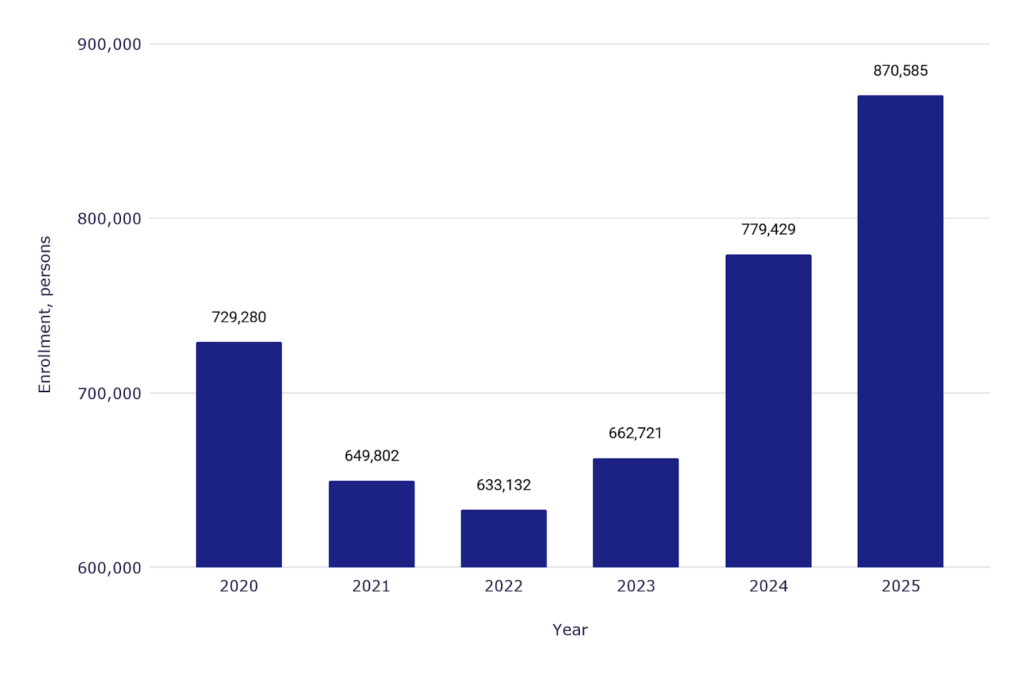
- Enrollment in vocational-focused community colleges (undergraduate students pursuing vocational programs within 2-year institutions) fell from 729,280 students in 2020 to 633,132 in 2022, a decline of nearly 96,000 students during the pandemic period.
- Vocational enrollment began recovering in 2023, rising to 662,721 students, marking an increase of 29,589 students year-over-year.
- By 2025, vocational-focused community colleges enrolled 870,585 students, up approximately 191,453 from 2022, reflecting sustained increasing enrollment.
Trade school and vocational college enrollment trends in the U.S.
The data show that vocational-focused community colleges experienced a notable decline during the pandemic, followed by sa trong recovery and growth. The rebound from 2023 to 2025 indicates a positive trajectory for increased enrollment in vocational programs, suggesting renewed interest in career-oriented postsecondary education. Overall, trade school enrollment trends and trade school enrollment statistics highlight that vocational college enrollment growth is becoming a significant component of the broader postsecondary enrollment landscape.
While absolute enrollment numbers illustrate recovery, examining year-over-year changes provides a clearer picture of vocational college enrollment growth and momentum in trade-focused programs.
Vocational-focused community colleges’ enrollment change: post-pandemic growth momentum
The chart presents annual percentage changes in vocational-focused community college enrollment from 2021 through 2025. By highlighting gains and losses, the data helps interpret trade school enrollment trends, trade school enrollment statistics, and patterns in enrolling in college for vocational programs.
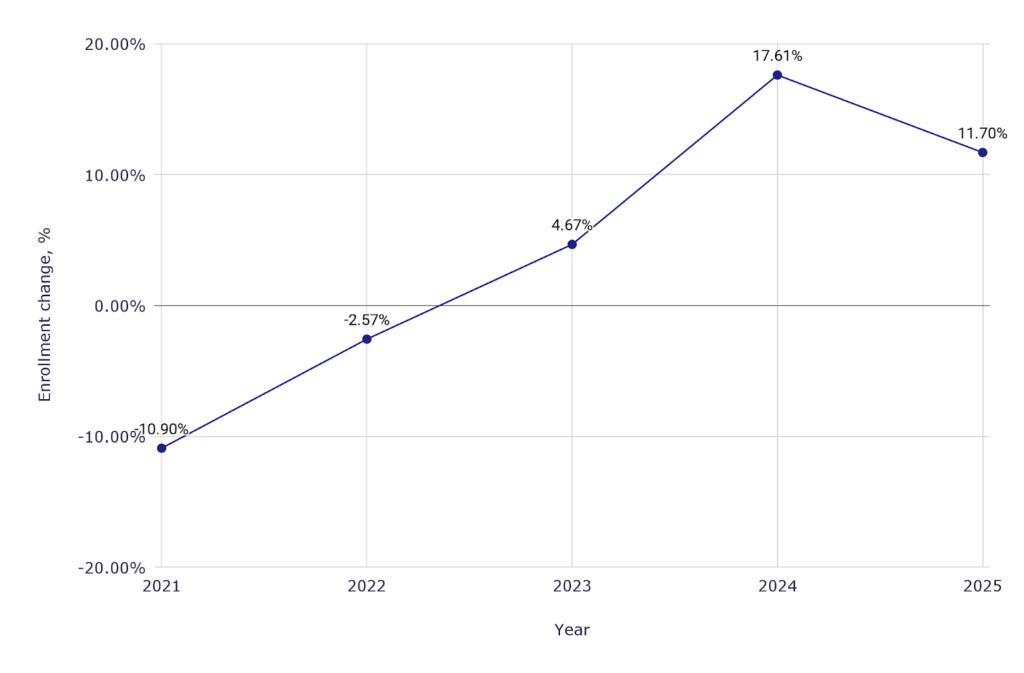
- Enrollment dropped sharply in 2021 by -10.90% and continued declining in 2022 by -2.57%, reflecting the immediate post-pandemic impact on vocational programs.
- Growth resumed in 2023 with a modest increase of +4.67%, signaling the beginning of recovery in vocational-focused enrollment.
- Enrollment surged in 2024 and 2025, rising by +17.61% and +11.70% respectively, demonstrating strong increasing enrollment momentum in vocational colleges.
Year-over-year vocational college enrollment growth trends
The year-over-year percentage changes show a clear transition from pandemic-related decline to sustained recovery and growth in vocational-focused community colleges. The sharp increases in 2024 and 2025 confirm that vocational college enrollment growth is accelerating, contributing to broader enrollment trends within trade-focused postsecondary education. Overall, the data underscores that trade school enrollment statistics and trade school enrollment trends are pointing to a robust rebound, with more students actively enrolling in college through vocational programs.
After examining overall enrollment trends, it is important to explore college student demographics to understand the gender composition of the undergraduate population before the pandemic.
Undergraduate demographics by gender before COVID-19
The chart presents the share of male and female undergraduate students in the U.S. from 1970 through 2019. This data provides insight into the demographics of college students, showing the long-term shift toward a female-majority undergraduate population.
- Women comprised 42.33% of undergraduate students in 1970, but by 1980, they represented a majority at 52.27%.
- From 2000 to 2019, the female share of undergraduates remained consistently above 56%, peaking at 57.17% in 2005.
- By 2019, women accounted for 56.82% of the undergraduate population, highlighting the enduring predominance of female students in U.S. higher education.
College enrollment by gender: trends in higher education demographics
| Year | Male, % | Female, % |
| 1970 | 57.67% | 42.33% |
| 1975 | 54.31% | 45.69% |
| 1980 | 47.73% | 52.27% |
| 1985 | 46.83% | 53.17% |
| 1986 | 46.47% | 53.53% |
| 1987 | 45.88% | 54.12% |
| 1988 | 45.40% | 54.60% |
| 1989 | 45.23% | 54.77% |
| 1990 | 44.98% | 55.02% |
| 1991 | 44.79% | 55.21% |
| 1992 | 44.53% | 55.47% |
| 1993 | 44.50% | 55.50% |
| 1994 | 44.22% | 55.78% |
| 1995 | 44.16% | 55.84% |
| 1996 | 43.97% | 56.03% |
| 1997 | 43.92% | 56.08% |
| 1998 | 43.79% | 56.21% |
| 1999 | 43.83% | 56.17% |
| 2000 | 43.92% | 56.08% |
| 2001 | 43.78% | 56.22% |
| 2002 | 43.43% | 56.57% |
| 2003 | 43.01% | 56.99% |
| 2004 | 42.89% | 57.11% |
| 2005 | 42.83% | 57.17% |
| 2006 | 42.89% | 57.11% |
| 2007 | 43.11% | 56.89% |
| 2008 | 43.17% | 56.83% |
| 2009 | 43.31% | 56.69% |
| 2010 | 43.34% | 56.66% |
| 2011 | 43.28% | 56.72% |
| 2012 | 43.50% | 56.50% |
| 2013 | 43.83% | 56.17% |
| 2014 | 43.87% | 56.13% |
| 2015 | 44.01% | 55.99% |
| 2016 | 43.95% | 56.05% |
| 2017 | 43.83% | 56.17% |
| 2018 | 43.50% | 56.50% |
| 2019 | 43.18% | 56.82% |
The data show that university demographics have shifted significantly over the past five decades, with women becoming the majority of undergraduates by 1980. This trend has remained stable, with the percentage of college students by race and gender indicating that female students consistently represent more than half of the college student demographics before COVID-19. Overall, the figures underscore that gender composition is a key component of higher education demographics and an important factor when analyzing trends in undergraduate enrollment.
Having reviewed pre-pandemic gender composition, it is now important to examine college student demographics after COVID-19 to understand how the pandemic affected the undergraduate gender balance.
Undergraduate demographics by gender after COVID-19
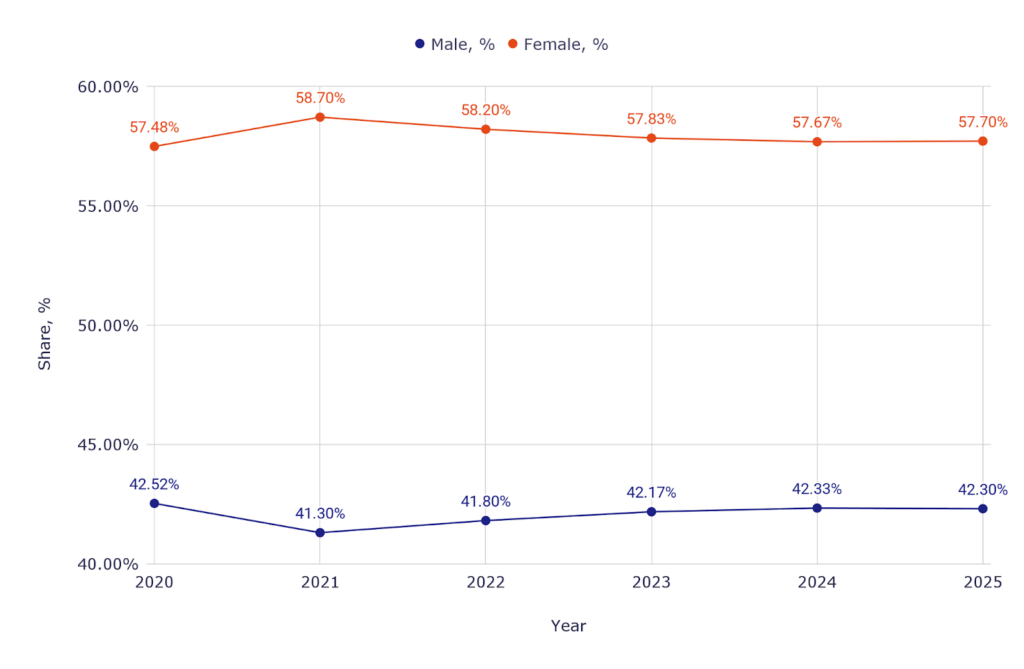
The chart shows the share of male and female undergraduate students in the U.S. from 2020 through 2025. By tracking changes in the demographics of college students, the data highlights how higher education demographics remained relatively stable in the post-pandemic period.
- Women consistently comprised the majority of undergraduates after COVID-19, representing 57.48% in 2020 and increasing to 58.70% in 2021.
- From 2022 through 2025, the female share of undergraduate students remained between 57.67% and 58.20%, indicating stability in gender composition.
- By fall 2024, women accounted for approximately 57.67% of the undergraduate population, maintaining the pre-pandemic pattern of female majority in higher education.
College enrollment by gender: post-pandemic trends in higher education demographics
The post-pandemic data demonstrates that the gender composition of undergraduates has remained stable, with women consistently forming the majority of students. These figures show that university demographics and the percentage of college students by race and gender did not experience major shifts due to COVID-19. Overall, the trends highlight that college student demographics continue to reflect a predominance of female students in U.S. higher education, reinforcing pre-existing patterns in higher education demographics.
Conclusions
The U.S. higher education system has experienced a prolonged decline in total and undergraduate enrollment that began well before the COVID-19 pandemic, reflecting structural shifts in demographics, participation patterns, and postsecondary pathways. Community colleges were particularly affected, with enrollment contracting sharply in the 2010s, while four-year institutions continued to grow, signaling a long-term reallocation of students within the public higher education sector.
The pandemic intensified these trends, causing the largest drops in community and vocational-focused college enrollment between 2020 and 2023. However, enrollment recovery began in 2024, with both community colleges and vocational programs showing strong growth by 2025. Vocational-focused colleges, in particular, demonstrated robust increasing enrollment momentum, indicating continued demand in career-oriented postsecondary education.
Gender composition among undergraduates has remained stable, with women consistently representing 57-58% of the student population before and after COVID-19, confirming persistent patterns in college demographics. Year-over-year data indicate that the recent enrollment growth is structurally grounded rather than a temporary rebound, suggesting that higher education participation is gradually stabilizing.
Overall, the trends in undergraduate, community college, and vocational-focused enrollment point to a resilient recovery, signaling that U.S. postsecondary education is adapting to demographic shifts, post-pandemic dynamics, and evolving student preferences, while maintaining consistent gender representation in the student body.
Sources
- “Clearinghouse Enrollment Insights Series: Current Term Enrollment Estimates Spring Report.” National Student Clearinghouse Research Center Home, 22 May 2025, https://nscresearchcenter.org/final-spring-enrollment-trends/. Accessed 19 December 2025.
- Fall Enrollment of U.S. Resident Students in Degree-Granting Postsecondary Institutions, by Race/Ethnicity: Selected Years, 1976 through 2023. https://nces.ed.gov/programs/digest/d24/tables/dt24_306.30.asp. Accessed 19 Dec. 2025. Accessed 19 December 2025.
- Total Fall Enrollment in Degree-Granting Postsecondary Institutions, by Attendance Status, Sex of Student, and Control of Institution: Selected Years, 1947 through 2023. https://nces.ed.gov/programs/digest/d24/tables/dt24_303.10.asp. Accessed 19 Dec. 2025. Accessed 19 December 2025.
- Total Fall Enrollment in Degree-Granting Postsecondary Institutions, by Level and Control of Institution and Race/Ethnicity or Nonresident Status of Student: Selected Years, 1976 through 2023. https://nces.ed.gov/programs/digest/d24/tables/dt24_306.20.asp. Accessed 19 Dec. 2025. Accessed 19 December 2025.
- Total Undergraduate Fall Enrollment in Degree-Granting Postsecondary Institutions, by Attendance Status, Sex of Student, and Control and Level of Institution: Selected Years, 1970 through 2023. https://nces.ed.gov/programs/digest/d24/tables/dt24_303.70.asp. Accessed 19 Dec. 2025. Accessed 19 December 2025.