



Key findings:
White students account for 41% of college students, while all other racial groups collectively represent 59% of the population.
Students of color make up approximately 40% of undergraduates, reflecting a substantial share of non-white enrollment.
Hispanic student enrollment increased from 9.9% in 2000 to 22.2% in 2023, representing the largest growth among all racial groups.
The percentage of Black students in college rose from 11.7% in 2000 to 13.4% in 2023, showing relatively stable long-term growth.
A gap of 31 percentage points exists between students and faculty, with 41% White students compared to 72% White faculty.
On some campuses, up to 93% of faculty are non-Black, indicating limited representation across specific groups.
Immigrant students account for nearly one-third of the college population, adding to overall ethnic diversity.
The number of college students in the U.S. increased from 15.3 million in 2000 to 21 million in 2010, before declining to 18.1 million in 2023.
The share of students considering leaving their college peaked at 41% in 2022 and declined to 32% in 2024.
Female students increased from 29.0% in 1947 to 57.6% in 2023, surpassing male students in 1979 at 50.9%.
Institutional diversity varies significantly, with non-white student shares ranging from 50% to 97% across universities.
The share of White students declined from 65% in 2000 to 41% in 2023, while minority students increased from 35% to 59%.
Higher education in the United States is becoming more diverse, but the structure and pace of these changes vary across institutions and student groups. Understanding ethnic diversity and student demographics is essential for evaluating how access to education is distributed and how representation is evolving.
This report examines diversity in education through a data-driven lens, focusing on racial diversity, enrollment patterns, and institutional differences. This analysis of college enrollment statistics and long-term trends provides a clearer picture of who is attending college and how the composition of students has shifted in recent decades.
The analysis covers key dimensions of diversity in higher education, including racial composition, minority enrollment, gender distribution, and differences across institutions. Together, these insights help explain how diversity is changing and where gaps in representation remain.
As higher education trends continue to evolve, understanding the composition of student populations provides a foundation for analyzing broader diversity patterns across institutions.
Racial diversity and college demographics by race in U.S. higher education
The chart below presents the percentage of college students by race, offering a clear view of college demographics by race and overall racial diversity in U.S. higher education. This breakdown highlights how college students by race are distributed across major ethnic groups and reflects current levels of ethnic diversity within the system.
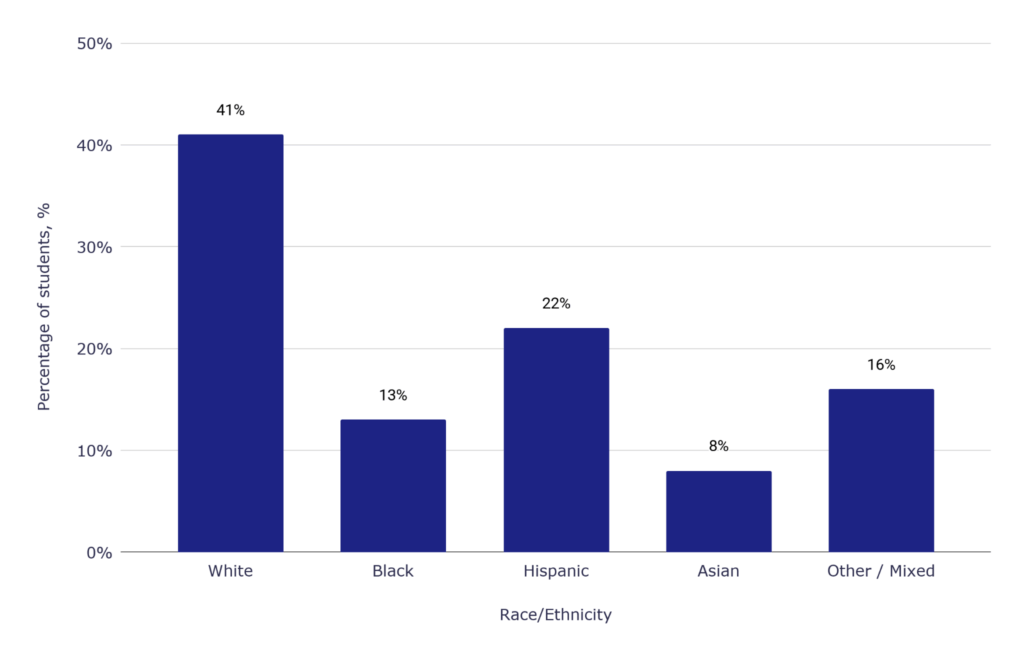
- White students account for 41% of college students by race, remaining the largest single group.
- Hispanic students represent 22% of the student population, exceeding Black students at 13% and Asian students at 8%.
- Students categorized as Other or Mixed make up 16%, indicating additional diversity beyond major racial categories.
Percentage of college students by race: A breakdown of ethnic diversity
Overall, the data shows that no single group constitutes an overwhelming majority, with White students at 41% and all other groups collectively representing 59%. This distribution reflects increasing ethnic diversity and highlights how college enrollment by race and gender trends contribute to a more balanced student population across U.S. institutions.
Building on the overall racial diversity of college populations, it is important to examine how representation among minority groups has changed over time.
Minority enrollment trends in U.S. colleges by race
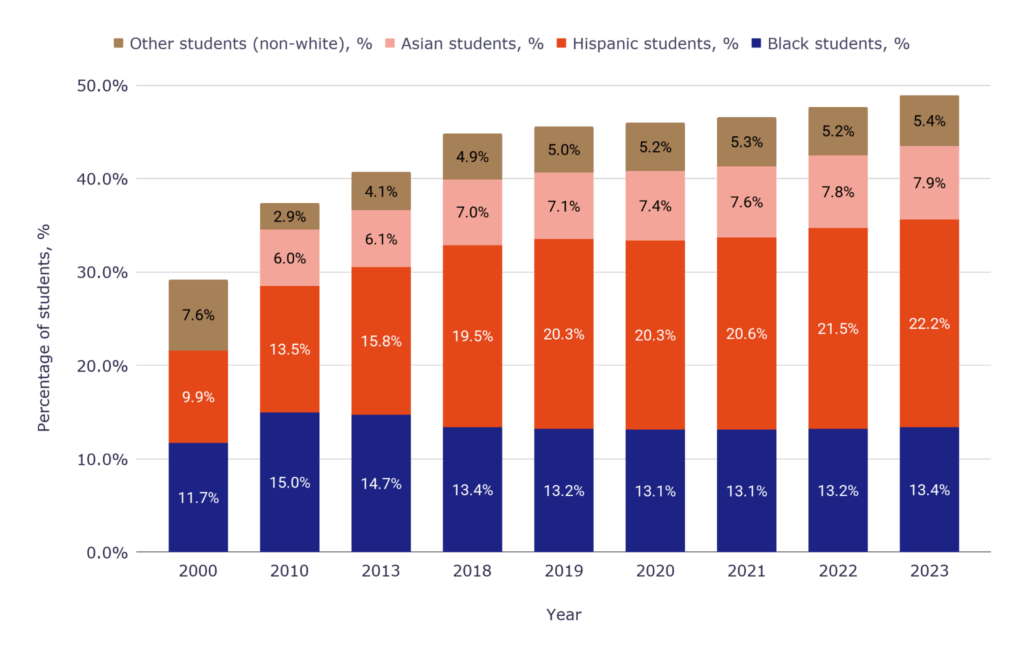
The chart below tracks minority enrollment trends across key groups, including the percentage of black students in college alongside Hispanic, Asian, and other non-white students. This time-series view helps contextualize questions such as what percentage of college students are black and how representation has evolved in comparison to other groups.
What percentage of black students go to college?
- The percentage of black students in college increased from 11.7% in 2000 to 13.4% in 2023, showing moderate long-term growth.
- Hispanic students grew significantly from 9.9% in 2000 to 22.2% in 2023, representing the largest increase among all groups.
- Asian student representation rose from 6.0% in 2010 to 7.9% in 2023, while other non-white students increased from 2.9% to 5.4% over the same period.
Percentage of Black students in college and Minority enrollment growth
| Year | Black students, % | Hispanic students, % | Asian students, % | Other students (non-white), %* |
| 2000 | 11.7% | 9.9% | – | 7.6% |
| 2010 | 15.0% | 13.5% | 6.0% | 2.9% |
| 2013 | 14.7% | 15.8% | 6.1% | 4.1% |
| 2018 | 13.4% | 19.5% | 7.0% | 4.9% |
| 2019 | 13.2% | 20.3% | 7.1% | 5.0% |
| 2020 | 13.1% | 20.3% | 7.4% | 5.2% |
| 2021 | 13.1% | 20.6% | 7.6% | 5.3% |
| 2022 | 13.2% | 21.5% | 7.8% | 5.2% |
| 2023 | 13.4% | 22.2% | 7.9% | 5.4% |
*Category definitions for ‘Other students’ vary across years
Overall, the data show that minority enrollment has expanded over time; the largest increase was observed among Hispanic students. While the percentage of black students in college has remained relatively stable in recent years, the broader composition of non-white student groups continues to diversify, providing additional context for understanding the percentage of black students who go to college and how representation compares across populations.
While student populations are becoming more diverse, differences between student and faculty composition reveal important gaps in campus diversity.
Campus diversity vs faculty representation in U.S. colleges
The chart below compares student diversity with faculty representation, highlighting the diversity of the student body versus the teaching staff. This comparison illustrates the diversity ratio between students and faculty and provides a clearer picture of diversity on college campuses.
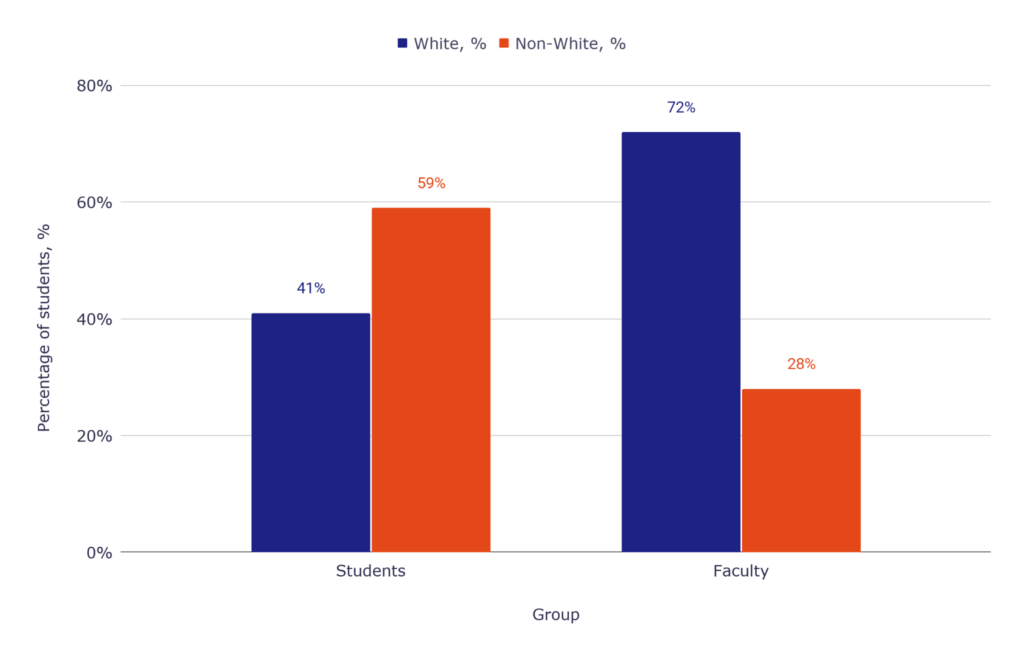
- White students represent 41% of the student body, compared to 72% among faculty, indicating a 31 percentage point gap.
- Non-white students account for 59% of the population, while non-white faculty make up only 28%, showing a 31 percentage point difference.
- The diversity ratio between students and faculty differs significantly, with student diversity at 59% non-white compared to 28% among faculty.
Diversity on college campuses: Student vs faculty composition
Overall, the data indicate that student diversity has advanced more rapidly than faculty representation. This imbalance suggests that while diversity on campus is increasing at the student level, faculty composition has not kept pace, resulting in a measurable gap in diversity on college campuses.
As differences in campus diversity continue to shape student experiences, retention patterns provide additional insight into how students respond to these environments. In addition to structural diversity trends, student behavior provides insight into how these changes affect engagement.
Student diversity and retention trends on college campuses
The chart below shows the share of students considering leaving their college over time, reflecting trends related to student diversity, diversity on campus, and overall engagement. This metric adds context to how the diversity of the student body may influence student decisions across institutions.
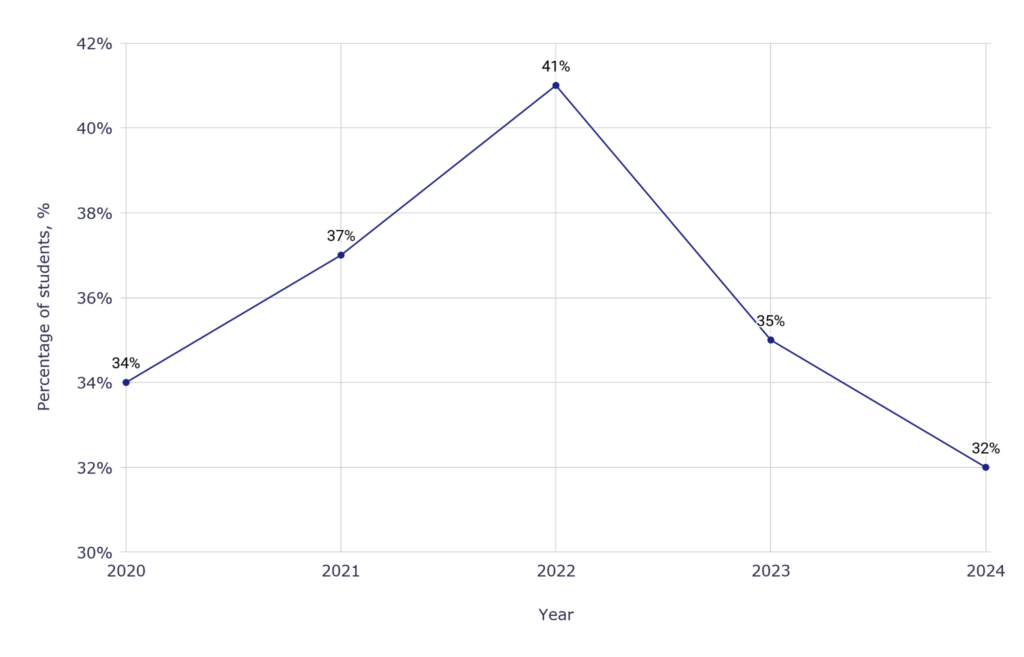
- The percentage of students considering leaving increased from 34% in 2020 to 41% in 2022.
- The rate declined from 41% in 2022 to 32% in 2024, indicating a 9 percentage point decrease.
- In 2023, 35% of students considered leaving, remaining above the 2020 level of 34%.
Student attrition trends and diversity on campus
Overall, the data suggest that student intent to leave fluctuates over time but remains a consistent factor across institutions. These patterns highlight how diversity on college campuses and broader campus conditions may correlate with retention trends, reinforcing the importance of monitoring student sentiment alongside student diversity metrics.
Following shifts in student retention and campus dynamics, it is important to understand the overall scale of higher education and how enrollment has changed over time.
How many college students are in the U.S.: Enrollment trends over time
The chart below presents college enrollment statistics, showing the number of college students in the US across key years. This data helps answer questions such as how many college students are in the US and provides context for how many people go to college overall.
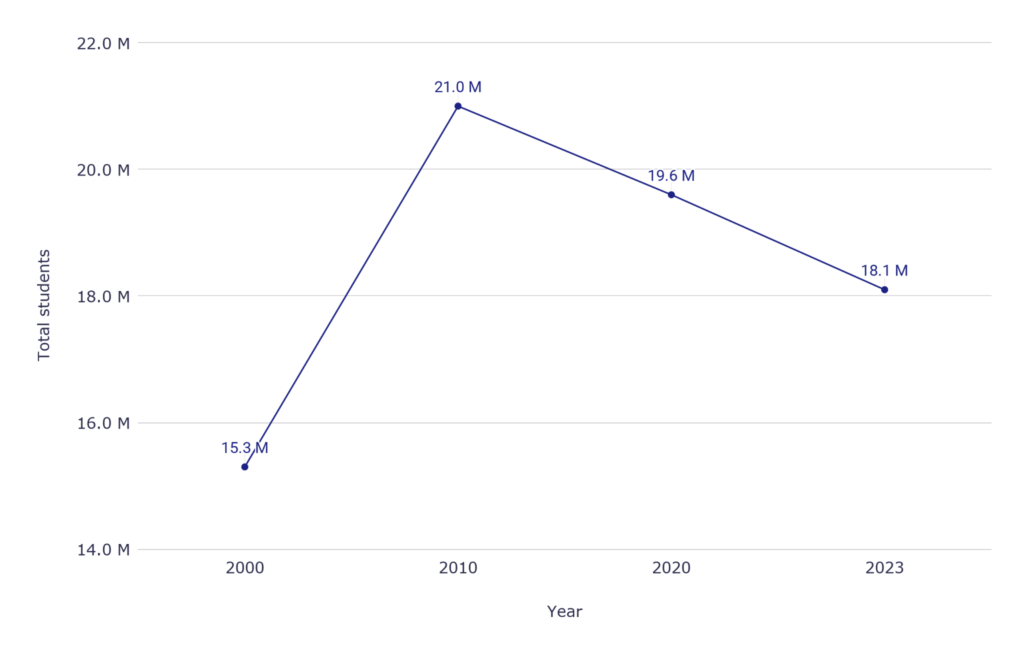
- The number of college students in the US increased from 15,300,000 in 2000 to 21,000,000 in 2010.
- Enrollment declined from 21,000,000 in 2010 to 18,100,000 in 2023, a decrease of 2,900,000 students.
- In 2020, total enrollment was 19,600,000, remaining higher than 2000 but below the 2010 peak.
Number of college students in the U.S. and enrollment statistics
Overall, the data show that while the number of college students in the US grew significantly in the early 2000s, enrollment has declined in recent years. These college enrollment statistics provide essential context for understanding how many people go to college and how participation levels are evolving.
After examining overall enrollment trends, it is important to look deeper into student demographics to understand how the composition of college populations has evolved.
Student demographics over time: Gender trends in U.S. colleges
The chart below presents long-term college student demographics, focusing on gender distribution across decades. This view of the demographics of college students highlights structural changes in participation and contributes to a broader understanding of American university demographics and higher education demographics.
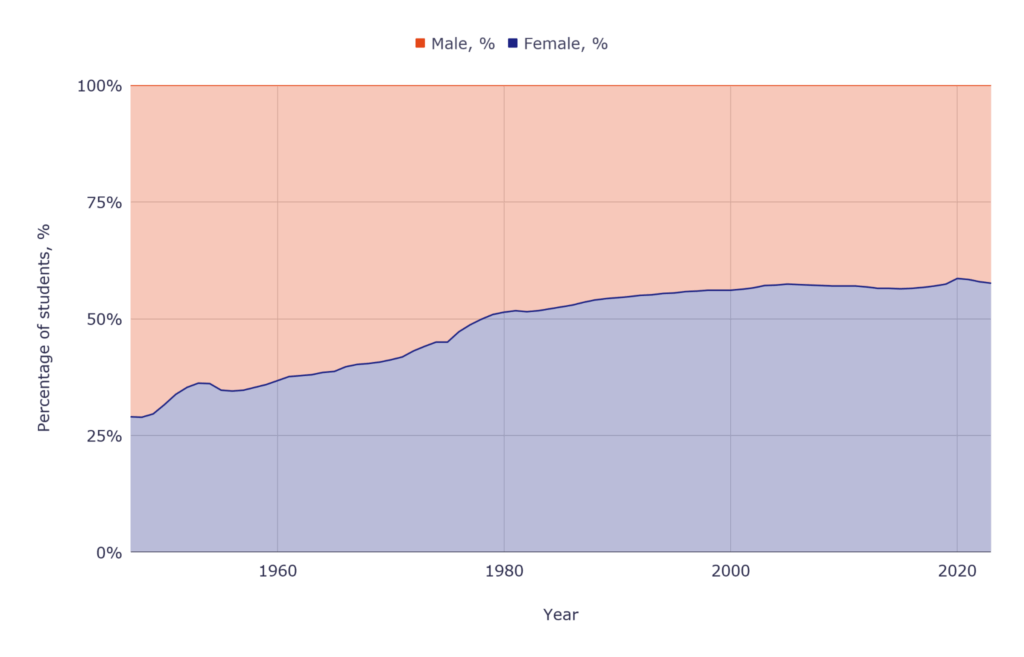
- Female students increased from 29.0% in 1947 to 57.6% in 2023, a rise of 28.6 percentage points.
- Male students declined from 71.0% in 1947 to 42.4% in 2023, a decrease of 28.6 percentage points.
- Female enrollment surpassed male enrollment in 1979, with 50.9% female compared to 49.1% male students.
College student demographics: Gender distribution in higher education
| Year | Female, % | Male, % |
| 1947 | 29.0% | 71.0% |
| 1948 | 28.9% | 71.1% |
| 1949 | 29.6% | 70.4% |
| 1950 | 31.6% | 68.4% |
| 1951 | 33.8% | 66.2% |
| 1952 | 35.3% | 64.7% |
| 1953 | 36.2% | 63.8% |
| 1954 | 36.1% | 63.9% |
| 1955 | 34.7% | 65.3% |
| 1956 | 34.5% | 65.5% |
| 1957 | 34.7% | 65.3% |
| 1959 | 35.9% | 64.1% |
| 1961 | 37.6% | 62.4% |
| 1963 | 38.0% | 62.0% |
| 1964 | 38.5% | 61.5% |
| 1965 | 38.7% | 61.3% |
| 1966 | 39.7% | 60.3% |
| 1967 | 40.2% | 59.8% |
| 1968 | 40.4% | 59.6% |
| 1969 | 40.7% | 59.3% |
| 1970 | 41.2% | 58.8% |
| 1971 | 41.8% | 58.2% |
| 1972 | 43.1% | 56.9% |
| 1973 | 44.1% | 55.9% |
| 1974 | 45.0% | 55.0% |
| 1975 | 45.0% | 55.0% |
| 1976 | 47.2% | 52.8% |
| 1977 | 48.7% | 51.3% |
| 1978 | 49.9% | 50.1% |
| 1979 | 50.9% | 49.1% |
| 1980 | 51.4% | 48.6% |
| 1981 | 51.7% | 48.3% |
| 1982 | 51.5% | 48.5% |
| 1983 | 51.7% | 48.3% |
| 1984 | 52.1% | 47.9% |
| 1985 | 52.5% | 47.5% |
| 1986 | 52.9% | 47.1% |
| 1987 | 53.5% | 46.5% |
| 1988 | 54.0% | 46.0% |
| 1989 | 54.3% | 45.7% |
| 1990 | 54.5% | 45.5% |
| 1991 | 54.7% | 45.3% |
| 1992 | 55.0% | 45.0% |
| 1993 | 55.1% | 44.9% |
| 1994 | 55.4% | 44.6% |
| 1995 | 55.5% | 44.5% |
| 1996 | 55.8% | 44.2% |
| 1997 | 55.9% | 44.1% |
| 1998 | 56.1% | 43.9% |
| 1999 | 56.1% | 43.9% |
| 2000 | 56.1% | 43.9% |
| 2001 | 56.3% | 43.7% |
| 2002 | 56.6% | 43.4% |
| 2003 | 57.1% | 42.9% |
| 2004 | 57.2% | 42.8% |
| 2005 | 57.4% | 42.6% |
| 2006 | 57.3% | 42.7% |
| 2007 | 57.2% | 42.8% |
| 2008 | 57.1% | 42.9% |
| 2009 | 57.0% | 43.0% |
| 2010 | 57.0% | 43.0% |
| 2011 | 57.0% | 43.0% |
| 2012 | 56.8% | 43.2% |
| 2013 | 56.5% | 43.5% |
| 2014 | 56.5% | 43.5% |
| 2015 | 56.4% | 43.6% |
| 2016 | 56.5% | 43.5% |
| 2017 | 56.7% | 43.3% |
| 2018 | 57.0% | 43.0% |
| 2019 | 57.4% | 42.6% |
| 2020 | 58.6% | 41.4% |
| 2021 | 58.4% | 41.6% |
| 2022 | 57.9% | 42.1% |
| 2023 | 57.6% | 42.4% |
Overall, the data shows a long-term shift in college student demographics, with female students becoming the majority over time. This trend reflects structural changes in higher education demographics and provides important context for understanding how participation patterns have evolved across generations.
Beyond national-level trends, differences between institutions provide additional insight into how diversity is distributed across the higher education system.
Most diverse colleges in the U.S. by student composition
The chart below presents a comparison of institutions based on the share of non-white students, offering a perspective on diversity across colleges.
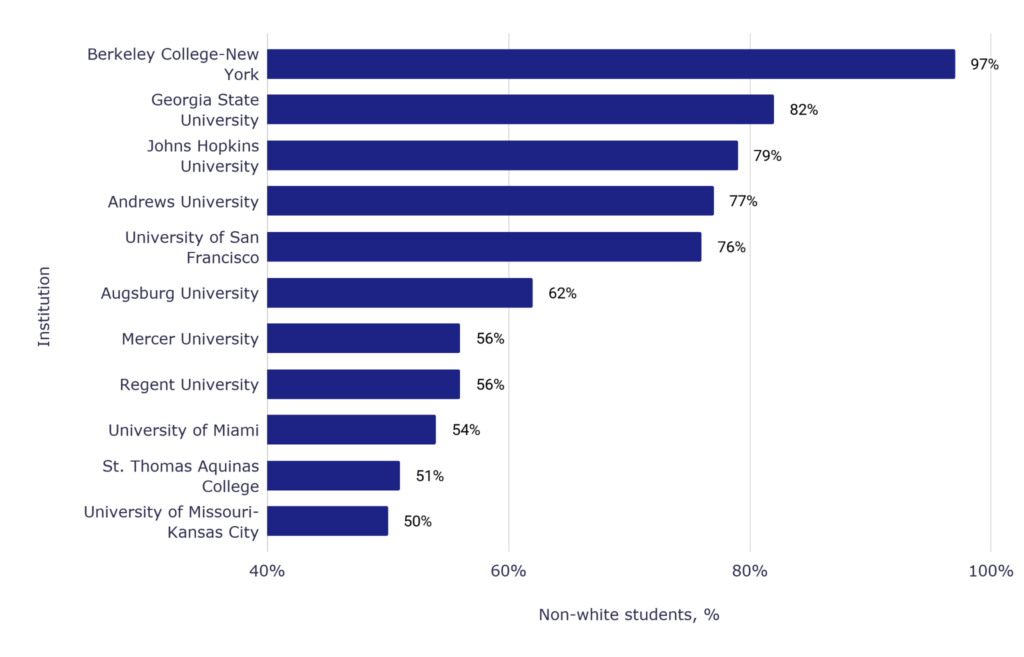
- Berkeley College-New York has the highest share of non-white students at 97%, followed by Georgia State University at 82%.
- Johns Hopkins University and Andrews University report 79% and 77% non-white students, respectively.
- The lowest value in the dataset is 50% at the University of Missouri-Kansas City, compared to 56% at both Mercer University and Regent University.
Diversity distribution across U.S. colleges by non-white student share
| Institution | Non-white students, % |
| Berkeley College-New York | 97% |
| Georgia State University | 82% |
| Johns Hopkins University | 79% |
| Andrews University | 77% |
| University of San Francisco | 76% |
| Augsburg University | 62% |
| Mercer University | 56% |
| Regent University | 56% |
| University of Miami | 54% |
| St. Thomas Aquinas College | 51% |
| University of Missouri-Kansas City | 50% |
Overall, the data shows a wide range in institutional diversity, with non-white student shares varying from 50% to 97%. This variation highlights how diversity is unevenly distributed across colleges, providing context for understanding differences between highly diverse institutions and those typically associated with the whitest colleges in America or white-only colleges.
Taken together, institutional differences and demographic shifts point to broader changes in diversity in higher education over time.
Diversity trends in higher education: Changing student composition
Building on current composition data, the chart below shows how diversity in higher education has evolved. This diversity in higher education statistics provides a clear view of how the overall diversity percentage has evolved within the U.S. college system.
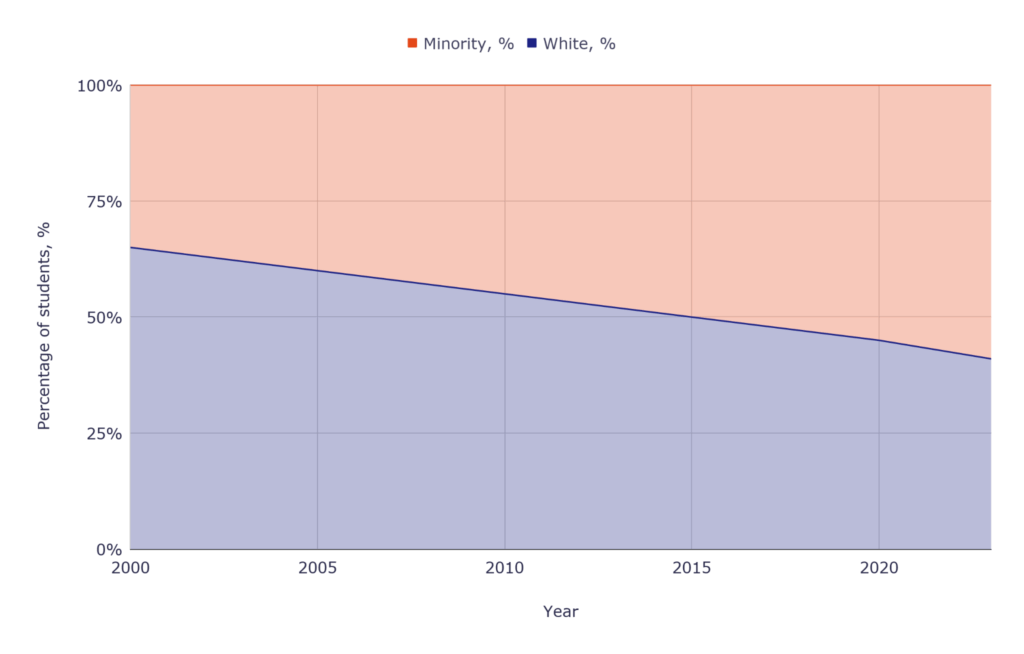
- The share of White students declined from 65% in 2000 to 41% in 2023, a decrease of 24 percentage points.
- Minority students increased from 35% in 2000 to 59% in 2023, surpassing White students after 2010.
- In 2020, minority students reached 55%, compared to 45% White students, marking a clear shift in composition.
Diversity statistics in U.S. colleges: Long-term trends
Overall, the data show a sustained increase in diversity in education, with minority students representing a growing share of the population. These diversity stats indicate a structural shift in diversity in higher education, where the balance between White and minority students has changed significantly over the past two decades.
Conclusions
The data shows that ethnic diversity has become a defining characteristic of U.S. higher education, with White students accounting for 41% of the population and all other groups representing 59%. Growth in minority enrollment, particularly among Hispanic students, increasing from 9.9% in 2000 to 22.2% in 2023, highlights a structural shift in racial diversity across institutions. At the same time, the percentage of black students in college has grown more gradually, indicating uneven progress across demographic groups.
Despite these changes in college demographics by race, gaps remain within institutions. Faculty composition continues to lag behind student diversity, with 72% White faculty compared to 41% White students, pointing to a persistent imbalance in diversity on college campuses. This disparity suggests that while access to education has broadened, representation in academic roles has not evolved at the same pace.
Enrollment trends further contextualize these shifts. The number of college students in the US peaked at 21 million in 2010 before declining to 18.1 million in 2023, indicating changes in participation levels. At the same time, college student demographics have undergone long-term transformation, with female students increasing from 29.0% in 1947 to 57.6% in 2023, reshaping the overall composition of higher education.
Institutional variation adds another layer to diversity in higher education, with non-white student shares ranging from 50% to 97% across universities. These differences highlight how diversity is unevenly distributed and reinforce the importance of analyzing both national trends and institution-level patterns. Overall, the data indicate that diversity in education is increasing, but structural gaps in representation and participation continue to define the landscape of U.S. higher education.
Sources
- Jane Nam, updated on September 10, 2025, edited. “Most Diverse Colleges | BestColleges.” Bestcolleges.com, https://www.bestcolleges.com/resources/most-diverse-colleges/. Accessed 19 March 2026.
- Marken, Stephanie. “One in Three College Students Consider Leaving Program.” Gallup, 1 May 2025, https://news.gallup.com/poll/659897/one-three-college-students-consider-leaving-program.aspx. Accessed 19 March 2026.
- Total Fall Enrollment in Degree-Granting Postsecondary Institutions, by Attendance Status, Sex of Student, and Control of Institution: Selected Years, 1947 through 2023. https://nces.ed.gov/programs/digest/d24/tables/dt24_303.10.asp. Accessed 19 March 2026.
- Total Fall Enrollment in Degree-Granting Postsecondary Institutions, by Level and Control of Institution and Race/Ethnicity or Nonresident Status of Student: Selected Years, 1976 through 2023. https://nces.ed.gov/programs/digest/d24/tables/dt24_306.20.asp. Accessed 19 March 2026.