



Key findings:
The percentage of students admitting to cheating increased from 60% in 2020 to 95% in 2025, marking a 35-percentage-point rise and indicating sustained growth in student cheating over time.
In physical classrooms, 52% of students admitted using AI for homework, while 58% admitted doing so online, making AI the most frequently reported form of cheating in college across formats.
Traditional in-person misconduct remains widespread, with 76% of students admitting to using a phone during an exam and 68% admitting to texting answers, highlighting persistent cheating in school during supervised assessments.
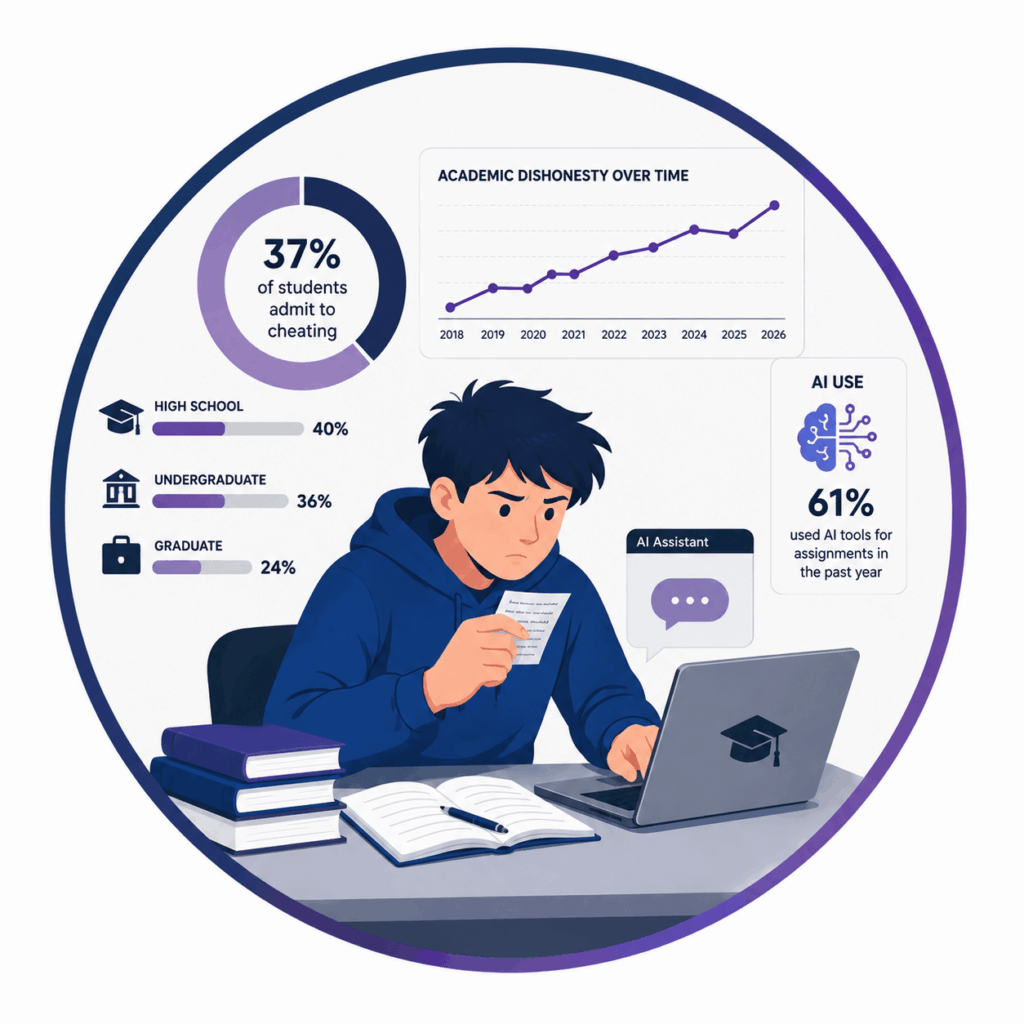
Overall admission rates are higher in higher education, with 70% of college/university students reporting cheating compared to 59% of high school students, indicating an 11-point increase at the tertiary level.
Collaboration-based misconduct is common, as 45% of students admitted to working individually but collaborating in physical settings, compared to 39% online, reinforcing how often students cheat in assignment-based evaluations.
Online environments show distinct patterns, with 51% of students admitting to looking up homework answers online and 33% looking up exam answers, while severe violations such as buying exam answers (4%) or letting someone take an exam (3.6%) remain relatively rare.
A perception gap exists around AI use: only 25% consider using AI for homework extremely serious, yet 52% admit doing it, suggesting normalization of AI-assisted academic dishonesty.
Every year, educators, parents, and journalists ask the same question: how many students cheat, and is it getting worse? From cheating in school exams to AI-assisted assignments, academic dishonesty statistics suggest that student behavior is evolving rapidly. What once meant copying answers during a test now includes looking up homework online, texting answers in real time, or using generative AI tools to complete assignments. The scale of student cheating today differs significantly from a decade ago.
Recent data shows that the percentage of students admitting to cheating has climbed significantly in recent years, with some datasets reporting levels as high as 95% in 2025. At the same time, more than half of students admit to using AI tools for homework at least once. These figures prompt further examination of how often students cheat, how common cheating is in college, and whether digital learning environments are accelerating the trend.
This article breaks down how many students cheat across years, education levels, and learning formats. We analyze self-reported behaviors, compare physical versus online classrooms, and examine the growing role of AI in academic misconduct. If you want a data-driven look at what percent of students cheat, and what the numbers really mean, the charts and insights below provide a clear, evidence-based picture of modern academic dishonesty.
Students’ cheating statistics by year: How many students cheat over time?
The chart below presents students’ cheating statistics by year, showing the percentage of students who admitted to cheating in selected years between 2020 and 2025. This breakdown helps answer the question, what percent of students cheat, and provides context for broader academic dishonesty statistics trends. By comparing these yearly figures, we can better assess student cheating growth over time and evaluate how rapidly cheating in school is changing.
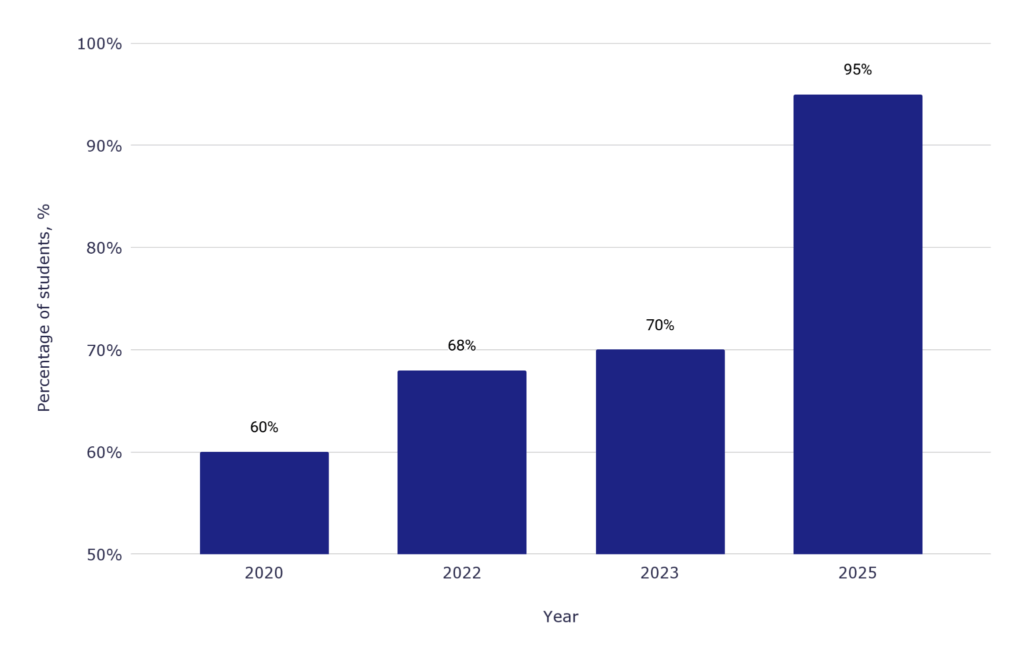
- The percentage of students who admitted to cheating increased from 60% in 2020 to 95% in 2025, marking a 35-point rise.
- Between 2022 (68%) and 2023 (70%), the growth was modest at just 2 percentage points.
- The sharpest jump occurred between 2023 (70%) and 2025 (95%), a dramatic 25-point increase in just two years.
Student cheating growth over time statistics: Percentage trends from 2020 to 2025
The data clearly indicate a strong upward trajectory in the number of students cheating over time. While the increase from 2020 to 2023 appears gradual, the spike to 95% in 2025 indicates a substantial increase in students’ cheating behavior. These figures contribute to ongoing discussions around how often students cheat and suggest that cheating in school may be becoming more normalized or more openly admitted. If this trajectory continues, future academic dishonesty statistics may reflect an even higher prevalence of cheating across educational institutions.
After examining how many students cheat over time, it is important to consider whether these patterns differ across education levels.
Academic dishonesty statistics by education level: High school vs college
The chart below compares the percentage of students who admit to cheating at different education levels. This breakdown helps answer key questions such as what percentage of students cheat in high school and how many students cheat in college. By contrasting high school and college environments, we can better understand how common cheating is in college relative to earlier academic stages.
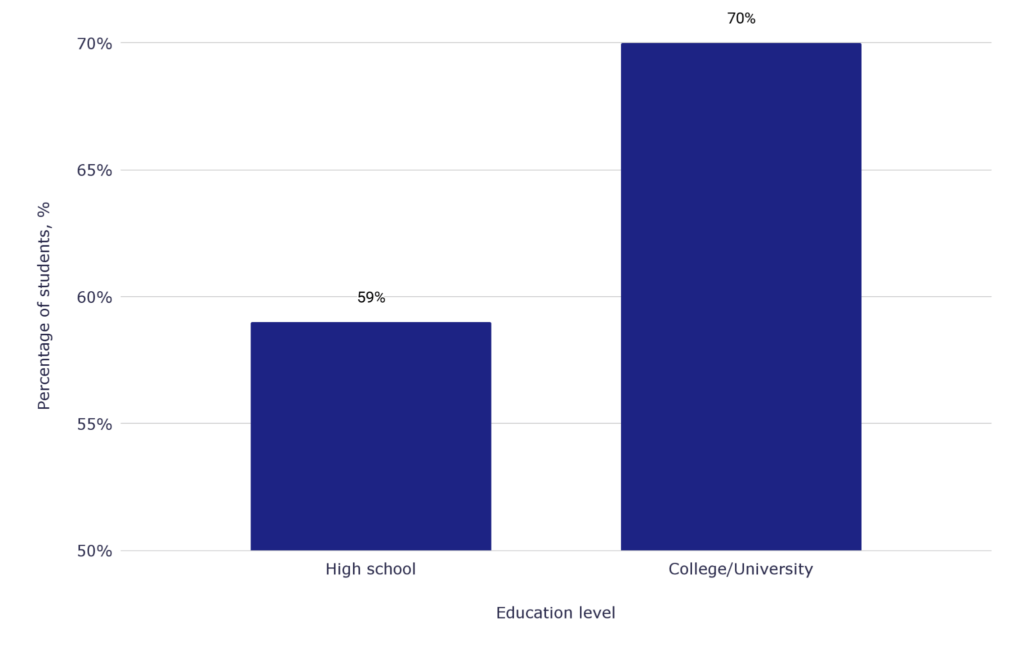
- 70% of college/university students admitted to cheating, compared to 59% of high school students, an 11-point difference.
- Cheating prevalence increases from 59% in high school to 70% in college, indicating higher exposure at the tertiary level.
- Nearly 7 in 10 college students (70%) report cheating, making cheating in college more widespread than in high school (59%).
What percentage of students cheat in high school vs college? A comparative view
The data suggest that academic dishonesty becomes more prevalent as students move into higher education. While cheating in school is already substantial at the high school level, the jump to 70% in college indicates that cheating in college may be influenced by greater academic pressure, independence, or opportunity. These findings contribute to broader discussions around how many students cheat and reinforce concerns about rising misconduct at the university level.
Beyond differences between high school and college, admission rates also vary depending on whether learning takes place in physical or online environments.
What percent of students cheat? Physical vs online admission rates
The chart below presents the percentage of students who admit to cheating at least once, comparing physical and online learning environments. These data provide a clearer picture of how many students cheat in college and help quantify the percentage of students who cheat in different academic contexts. By separating physical and online settings, we can better understand where academic dishonesty statistics reveal higher behavioral risks.
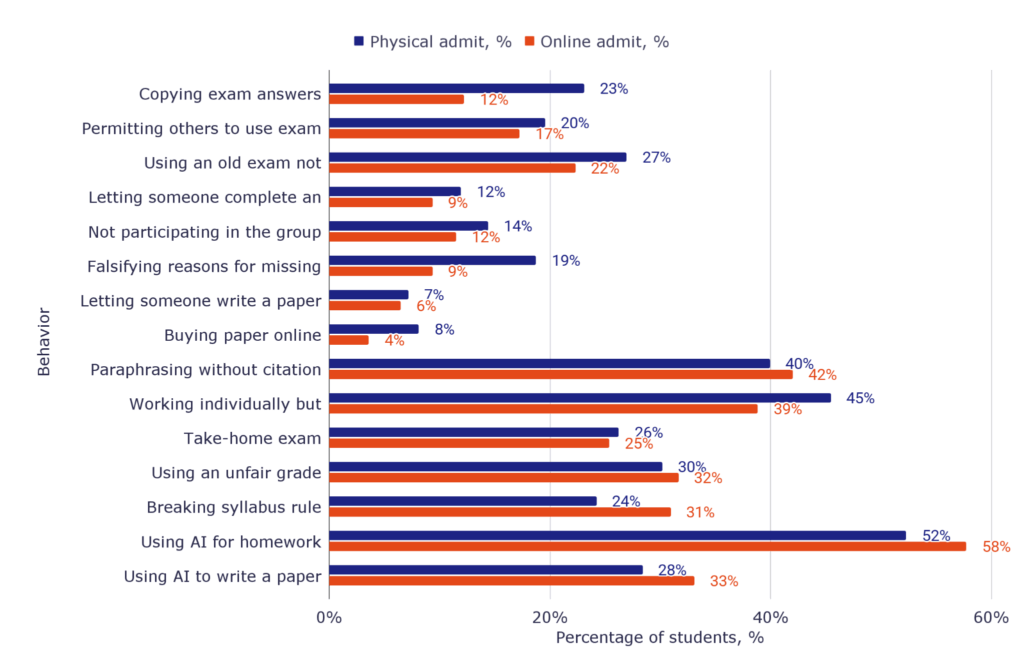
- The highest self-reported behavior was using AI for homework, with 52% in physical classes and 58% online admitting it at least once.
- 45% of students admitted collaborating when asked to work individually in physical settings, compared to 39% online.
- Traditional exam cheating, such as copying answers, was reported by 23% in physical classrooms versus 12% online, showing an 11-point gap.
How many students cheat in college: Self-reported rates by learning format
| Behavior | Physical admit, % | Online admit, % |
| Copying exam answers | 23% | 12% |
| Permitting others to use exam answers | 20% | 17% |
| Using an old exam not available to others | 27% | 22% |
| Letting someone complete an assignment | 12% | 9% |
| Not participating in the group assignment | 14% | 12% |
| Falsifying reasons for missing the exam | 19% | 9% |
| Letting someone write a paper | 7% | 6% |
| Buying paper online | 8% | 4% |
| Paraphrasing without citation | 40% | 42% |
| Working individually but collaborating | 45% | 39% |
| Take-home exam collaboration | 26% | 25% |
| Using an unfair grade advantage | 30% | 32% |
| Breaking syllabus rule | 24% | 31% |
| Using AI for homework | 52% | 58% |
| Using AI to write a paper | 28% | 33% |
The data show that the number of college students who cheat varies significantly by behavior and environment. In many traditional cheating scenarios, physical classrooms report higher admission rates, while online environments show elevated levels of AI use and rule-breaking behaviors. Notably, AI-related behaviors now rank among the most commonly admitted forms of cheating, surpassing several traditional misconduct types. Overall, these cheating statistics suggest that cheating in college is not limited to one format but is evolving alongside digital tools and assessment methods.
While overall admission rates differ by format, certain specific behaviors, particularly phone use during exams, remain highly prevalent in physical classrooms.
What percent of students cheat with their phones during exams?
The chart below highlights the percentage of students who admit to using their phones during in-person exams. These figures help answer the question, what percent of students cheat with their phones, and shed light on how often students cheat in monitored classroom settings. Unlike digital homework misconduct, these behaviors occur during supervised testing environments, making them particularly concerning.
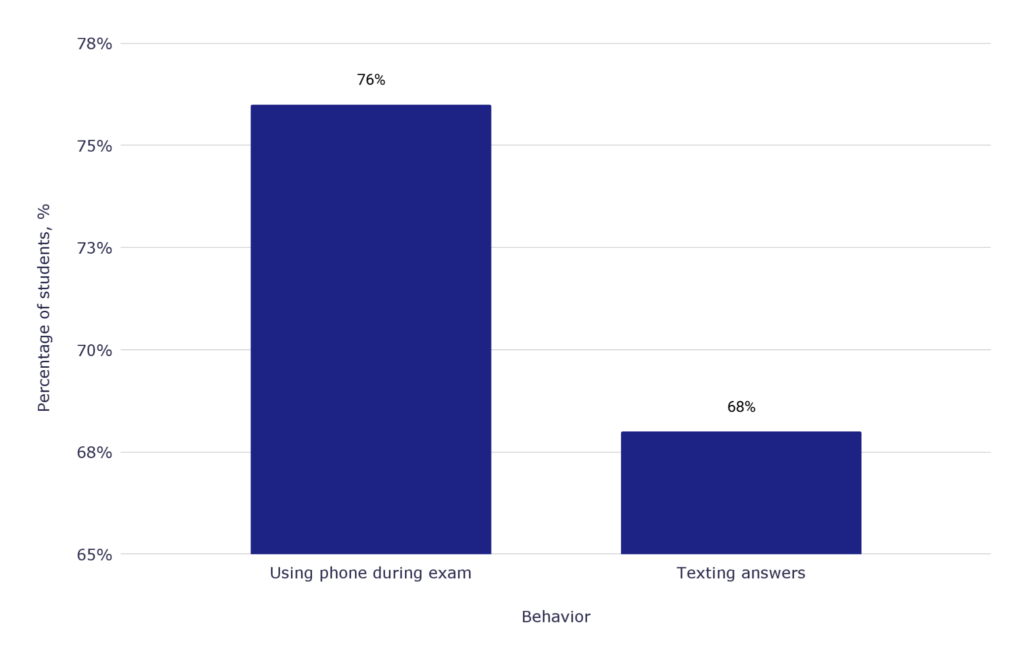
- 76% of students admitted to using a phone during an exam, making it the most reported behavior in this dataset.
- 68% reported texting answers during an exam, just 8 percentage points lower than general phone use (76%).
- More than two-thirds of students (68%) engaged in real-time answer sharing during exams, indicating widespread student cheating in physical classrooms.
Cheating in school: Phone use and texting during exams
The data shows that phone-related misconduct during exams is extremely common in physical classrooms. With 76% admitting to phone use and 68% admitting to texting answers, cheating in school appears to be highly prevalent, even in supervised environments. These figures significantly influence how many students cheat in exams and suggest that enforcement, monitoring, and exam design strategies may require reassessment to address modern cheating behaviors effectively.
In contrast to in-person exam misconduct, online environments introduce a different set of cheating behaviors shaped by digital access and remote assessment formats.
How common is cheating in college? Most frequent online behaviors
The chart below highlights the most common online cheating behaviors based on self-reported admissions. These figures help quantify how common cheating in college is within virtual learning environments and provide practical academic dishonesty statistics for online coursework. By examining specific behaviors, we gain a clearer understanding of how many students cheat when assessments move online.
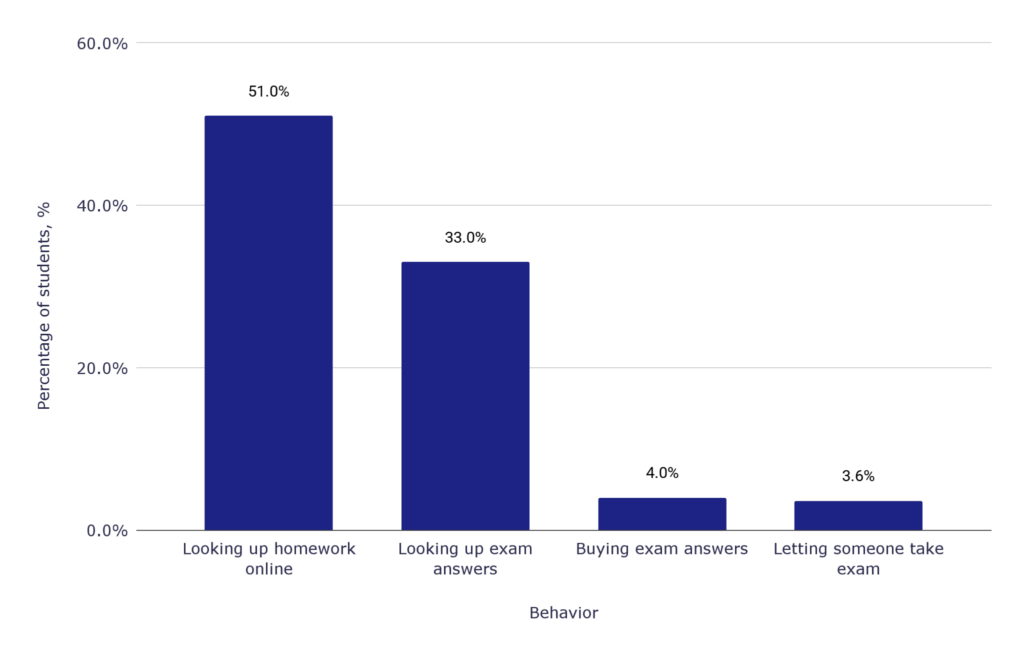
- The most frequently admitted behavior was looking up homework online (51.0%), meaning more than half of students reported doing it at least once.
- 33.0% of students admitted to looking up exam answers online, making it the second most common behavior.
- Severe forms of misconduct were rare, with only 4.0% buying exam answers and 3.6% letting someone take an exam, both below 5%.
Cheating in college: The most common online cheating behaviors
The data shows that online cheating is largely driven by accessible information rather than extreme forms of fraud. Over half of students admitted searching for homework answers online, reinforcing concerns about how often students cheat in unproctored digital settings. However, more serious violations, such as impersonation or purchasing answers, remain relatively uncommon. Overall, these cheating students statistics suggest that the convenience of online resources plays a central role in shaping cheating in college behavior patterns.
Among these digital behaviors, AI-assisted work represents a distinct category that warrants closer examination of both usage and perceived seriousness.
ChatGPT students cheating: AI perception vs real usage
The chart below compares how students perceive AI-based cheating with how often they actually engage in it. Specifically, it contrasts the percentage who consider AI use “extremely serious” with the percentage who admit using it at least once. This comparison provides insight into ChatGPT students’ cheating behavior and helps explain how many students cheat when AI tools are involved.
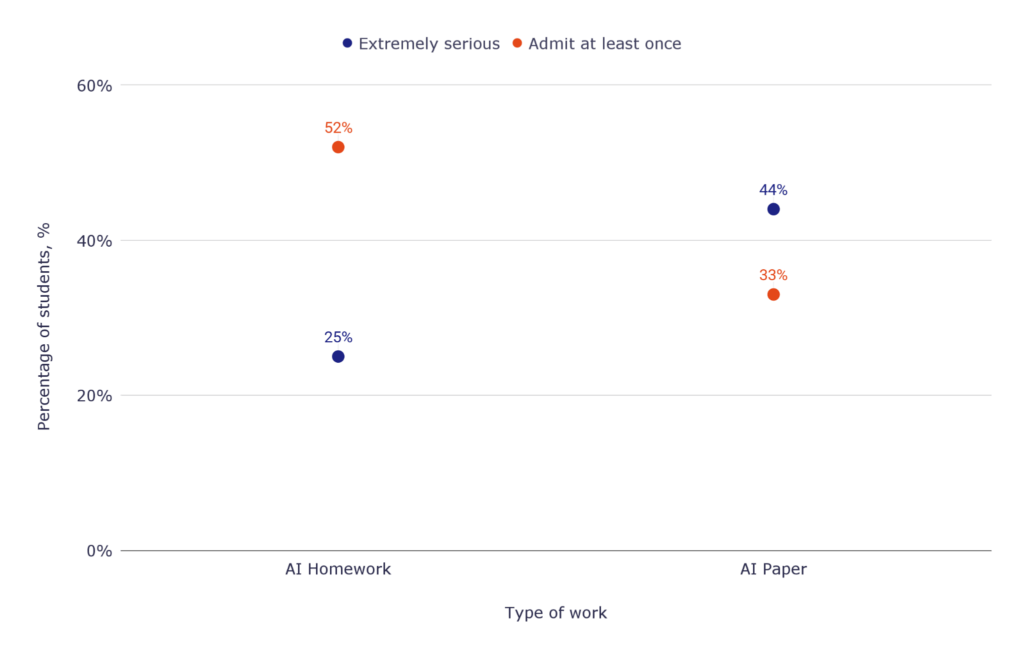
- Only 25% of students consider using AI for homework extremely serious, yet 52% admit doing it at least once, a 27-point gap.
- For AI paper writing, 44% rate it as extremely serious, while 33% admit using it, an 11-point difference.
- AI homework use (52%) is the most frequently admitted behavior in this dataset, exceeding AI paper writing (33%) by 19 percentage points.
Academic dishonesty statistics: How students view and use AI for cheating
The data reveals a clear perception–behavior gap in AI-related cheating. Although a minority of students view AI homework use as extremely serious (25%), more than half admit engaging in it (52%), suggesting normalization of AI-assisted work. In contrast, AI paper writing is perceived as more serious (44%) and shows lower self-reported use (33%), indicating that perceived severity still influences behavior. Overall, these findings highlight a shifting landscape in cheating in college, where AI tools are both widely used and inconsistently judged in terms of seriousness.
Conclusions
The data indicate that academic dishonesty represents a widespread and evolving feature of modern education. With the percentage of students admitting to cheating rising from 60% in 2020 to 95% in 2025, the upward trajectory suggests that student cheating has accelerated significantly in recent years. This growth, particularly the 25-point jump between 2023 and 2025, points to a structural shift rather than isolated behavioral spikes.
Differences across education levels and learning formats further reinforce this pattern. Cheating in college (70%) exceeds high school levels (59%), and admission rates vary between physical and online environments depending on the behavior. While traditional in-person misconduct, such as phone use during exams, remains extremely high at 76%, digital behaviors like looking up homework answers online (51%) and using AI for homework (52-58%) now dominate academic dishonesty statistics.
The rise of AI represents a particularly transformative development. Only 25% of students consider AI homework use extremely serious, yet more than half admit engaging in it, revealing a substantial perception–behavior gap. This normalization of AI-assisted work signals that technological access is reshaping how often students cheat and how misconduct is rationalized.
Overall, the convergence of rising admission rates, strong AI adoption, persistent exam misconduct, and higher prevalence in college environments suggests that academic dishonesty may represent a sustained behavioral trend across educational systems. Rather than isolated incidents, the data points to a broad behavioral shift influenced by digital access, assessment design, and changing attitudes toward academic integrity.
Sources
- View of Comparing Student Attitudes of Cheating Behaviors in the Physical and Online Environments with an Emphasis on AI Usage. https://academic-publishing.org/index.php/ejel/article/view/4256/2415. Accessed 11 February 2026.