



Key findings:
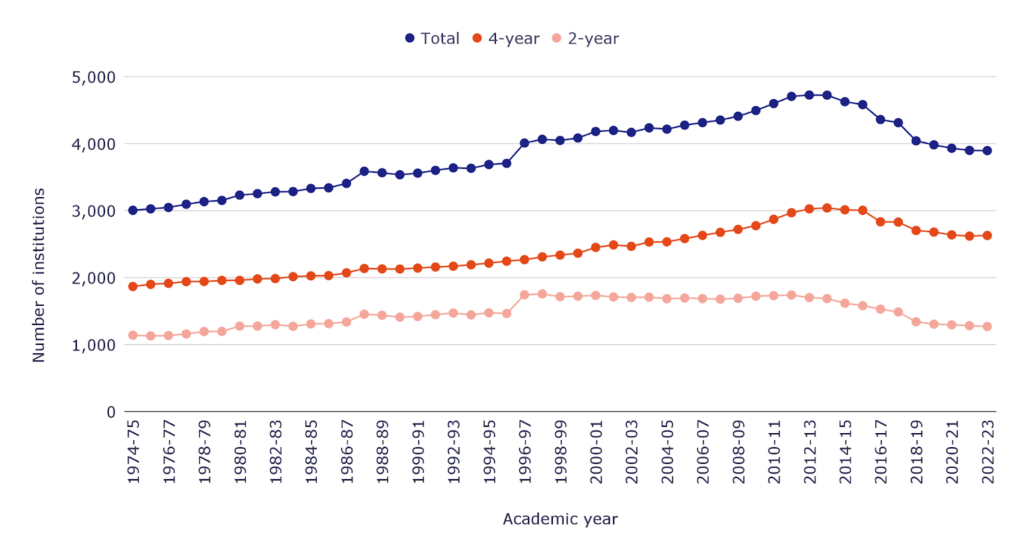
The total number of U.S. colleges and universities has declined from a 2012 peak of 4,726 to 3,896 in 2022-23, reflecting a decade of consolidation.
Four-year institutions remain dominant, totaling 2,628 in 2022-23, while 2-year colleges have contracted sharply to 1,268, their lowest level in decades.
Private institutions fell from 3,103 in 2012-13 to 2,297 today, driven largely by a collapse in for-profit colleges, down from 1,451 to 683.
California leads the nation with 403 colleges, while Delaware, Alaska, and Wyoming have fewer than 10 each, highlighting stark state-level disparities.
Public 4-year universities show long-term growth, reaching 782 institutions in 2022-23, even as public 2-year colleges dropped from 1,092 to 817.
Average enrollment at public institutions rose to 8,648 students per campus in 2023, nearly four times that of private colleges (2,269).
The largest U.S. universities now enroll 43,000-65,000 undergraduates, with Arizona State University topping 65,450 students in 2024.
The United States has a large and complex higher education system. From large public universities to small private colleges, the country offers a wide range of options for students seeking undergraduate and graduate education. Understanding how many colleges and universities are in the U.S. can help prospective students, educators, and policymakers gain insight into the scale, distribution, and accessibility of higher education across the nation.
In this article, we explore the total number of U.S. colleges and universities, their types, regional distribution, and trends over time. Whether you are curious about the number of public versus private institutions or how nonprofit and for-profit colleges contribute to the higher education landscape, this guide provides a comprehensive look at the U.S. education system.
Overview of higher education institutions in the U.S.
Number of U.S. colleges and universities by year
Understanding how many colleges are in the U.S. and how the landscape of colleges and universities in the U.S. has evolved is essential for analyzing long-term shifts in American higher education. The data below tracks the total count of colleges and universities annually, offering a clear year-by-year view of institutional expansion and consolidation.
These trends also help answer widely searched questions, such as how many universities are in the U.S. and the number of colleges in the U.S. by year.
How many colleges and universities are in the U.S.?
- The total number of U.S. institutions peaked at 4,726 in 2012-13, before gradually declining to 3,896 by 2022-23.
How many 4-year colleges are in the U.S.?
- Four-year institutions rose steadily from 1,866 in 1974-75 to a high of 3,039 in 2013-14, followed by a slight decrease to 2,628 in 2022-23.
How many 2-year colleges are in the U.S.?
- Two-year institutions experienced a long-term contraction, falling from 1,742 in 1996-97 to just 1,268 in 2022-23.
Historical trends in the number of colleges and universities in the U.S.
| Academic year | Total institutions | 4-year institutions | 2-year institutions |
| 1974-75 | 3,004 | 1,866 | 1,138 |
| 1975-76 | 3,026 | 1,898 | 1,128 |
| 1976-77 | 3,046 | 1,913 | 1,133 |
| 1977-78 | 3,095 | 1,938 | 1,157 |
| 1978-79 | 3,134 | 1,941 | 1,193 |
| 1979-80 | 3,152 | 1,957 | 1,195 |
| 1980-81 | 3,231 | 1,957 | 1,274 |
| 1981-82 | 3,253 | 1,979 | 1,274 |
| 1982-83 | 3,280 | 1,984 | 1,296 |
| 1983-84 | 3,284 | 2,013 | 1,271 |
| 1984-85 | 3,331 | 2,025 | 1,306 |
| 1985-86 | 3,340 | 2,029 | 1,311 |
| 1986-87 | 3,406 | 2,070 | 1,336 |
| 1987-88 | 3,587 | 2,135 | 1,452 |
| 1988-89 | 3,565 | 2,129 | 1,436 |
| 1989-90 | 3,535 | 2,127 | 1,408 |
| 1990-91 | 3,559 | 2,141 | 1,418 |
| 1991-92 | 3,601 | 2,157 | 1,444 |
| 1992-93 | 3,638 | 2,169 | 1,469 |
| 1993-94 | 3,632 | 2,190 | 1,442 |
| 1994-95 | 3,688 | 2,215 | 1,473 |
| 1995-96 | 3,706 | 2,244 | 1,462 |
| 1996-97 | 4,009 | 2,267 | 1,742 |
| 1997-98 | 4,064 | 2,309 | 1,755 |
| 1998-99 | 4,048 | 2,335 | 1,713 |
| 1999-2000 | 4,084 | 2,363 | 1,721 |
| 2000-01 | 4,182 | 2,450 | 1,732 |
| 2001-02 | 4,197 | 2,487 | 1,710 |
| 2002-03 | 4,168 | 2,466 | 1,702 |
| 2003-04 | 4,236 | 2,530 | 1,706 |
| 2004-05 | 4,216 | 2,533 | 1,683 |
| 2005-06 | 4,276 | 2,582 | 1,694 |
| 2006-07 | 4,314 | 2,629 | 1,685 |
| 2007-08 | 4,352 | 2,675 | 1,677 |
| 2008-09 | 4,409 | 2,719 | 1,690 |
| 2009-10 | 4,495 | 2,774 | 1,721 |
| 2010-11 | 4,599 | 2,870 | 1,729 |
| 2011-12 | 4,706 | 2,968 | 1,738 |
| 2012-13 | 4,726 | 3,026 | 1,700 |
| 2013-14 | 4,724 | 3,039 | 1,685 |
| 2014-15 | 4,627 | 3,011 | 1,616 |
| 2015-16 | 4,583 | 3,004 | 1,579 |
| 2016-17 | 4,360 | 2,832 | 1,528 |
| 2017-18 | 4,313 | 2,828 | 1,485 |
| 2018-19 | 4,042 | 2,703 | 1,339 |
| 2019-20 | 3,982 | 2,679 | 1,303 |
| 2020-21 | 3,931 | 2,637 | 1,294 |
| 2021-22 | 3,899 | 2,619 | 1,280 |
| 2022-23 | 3,896 | 2,628 | 1,268 |
Overall, the number of U.S. higher education institutions has gone through a notable rise followed by a decade of contraction. Growth from the mid-1970s through the early 2010s was driven largely by the expansion of four-year colleges, while the recent decline reflects the consolidation of both public and private institutions, especially among two-year colleges.
After examining the overall higher education landscape, this section focuses specifically on how the number of public institutions has evolved.
College and university numbers by state and type
Annual trends in the total number of public colleges and universities
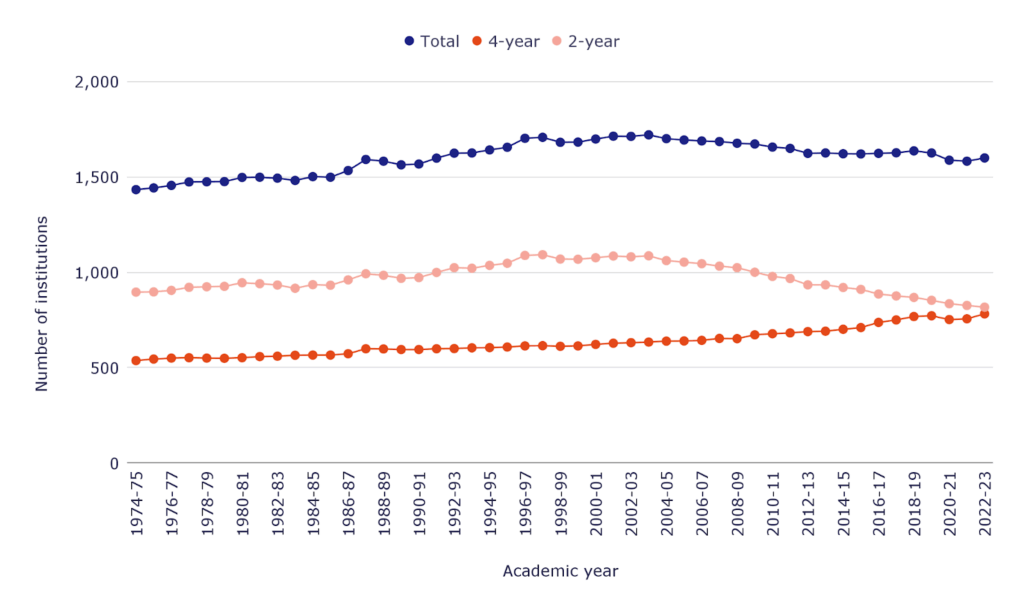
Understanding how many public universities in the U.S. exist and how their totals have shifted across decades is essential for analyzing long-term educational capacity. These year-by-year data also help contextualize broader questions, such as how many 4-year colleges are in the U.S., and the number of colleges by type. By tracking both 4-year and 2-year public institutions, the chart illustrates structural changes within the public sector of American higher education.
How many public universities are in the U.S.?
- The total number of public institutions rose from 1,433 in 1974-75 to a peak of 1,702 in 1996-97, before settling at 1,599 in 2022-23 after fluctuating in the intervening years..
- Public 4-year institutions increased steadily from 537 in 1974-75 to 782 in 2022-23, marking one of the most consistent growth patterns in the dataset.
- Public 2-year institutions grew from 896 in 1974-75 to a high of 1,092 in 1997-98, then declined to 817 by 2022-23.
Year-by-year changes in U.S. public colleges and universities
| Academic year | Total institutions | 4-year institutions | 2-year institutions |
| 1974-75 | 1,433 | 537 | 896 |
| 1975-76 | 1,442 | 545 | 897 |
| 1976-77 | 1,455 | 550 | 905 |
| 1977-78 | 1,473 | 552 | 921 |
| 1978-79 | 1,474 | 550 | 924 |
| 1979-80 | 1,475 | 549 | 926 |
| 1980-81 | 1,497 | 552 | 945 |
| 1981-82 | 1,498 | 558 | 940 |
| 1982-83 | 1,493 | 560 | 933 |
| 1983-84 | 1,481 | 565 | 916 |
| 1984-85 | 1,501 | 566 | 935 |
| 1985-86 | 1,498 | 566 | 932 |
| 1986-87 | 1,533 | 573 | 960 |
| 1987-88 | 1,591 | 599 | 992 |
| 1988-89 | 1,582 | 598 | 984 |
| 1989-90 | 1,563 | 595 | 968 |
| 1990-91 | 1,567 | 595 | 972 |
| 1991-92 | 1,598 | 599 | 999 |
| 1992-93 | 1,624 | 600 | 1,024 |
| 1993-94 | 1,625 | 604 | 1,021 |
| 1994-95 | 1,641 | 605 | 1,036 |
| 1995-96 | 1,655 | 608 | 1,047 |
| 1996-97 | 1,702 | 614 | 1,088 |
| 1997-98 | 1,707 | 615 | 1,092 |
| 1998-99 | 1,681 | 612 | 1,069 |
| 1999-2000 | 1,682 | 614 | 1,068 |
| 2000-01 | 1,698 | 622 | 1,076 |
| 2001-02 | 1,713 | 628 | 1,085 |
| 2002-03 | 1,712 | 631 | 1,081 |
| 2003-04 | 1,720 | 634 | 1,086 |
| 2004-05 | 1,700 | 639 | 1,061 |
| 2005-06 | 1,693 | 640 | 1,053 |
| 2006-07 | 1,688 | 643 | 1,045 |
| 2007-08 | 1,685 | 653 | 1,032 |
| 2008-09 | 1,676 | 652 | 1,024 |
| 2009-10 | 1,672 | 672 | 1,000 |
| 2010-11 | 1,656 | 678 | 978 |
| 2011-12 | 1,649 | 682 | 967 |
| 2012-13 | 1,623 | 689 | 934 |
| 2013-14 | 1,625 | 691 | 934 |
| 2014-15 | 1,621 | 701 | 920 |
| 2015-16 | 1,620 | 710 | 910 |
| 2016-17 | 1,623 | 737 | 886 |
| 2017-18 | 1,626 | 750 | 876 |
| 2018-19 | 1,636 | 768 | 868 |
| 2019-20 | 1,625 | 772 | 853 |
| 2020-21 | 1,587 | 752 | 835 |
| 2021-22 | 1,582 | 756 | 826 |
| 2022-23 | 1,599 | 782 | 817 |
The long-term trend shows that public higher education expanded throughout the late 20th century, driven initially by growth in 2-year colleges and later by steady increases in 4-year institutions. Over the past two decades, however, the number of public 2-year colleges has contracted, while 4-year colleges have continued to rise, reshaping the balance of public education offerings. These dynamics reflect demographic changes, funding shifts, and evolving student demand across states.
After reviewing public institutions, this section examines how the private sector has expanded and changed across academic years.
Annual trends in the total number of private colleges and universities
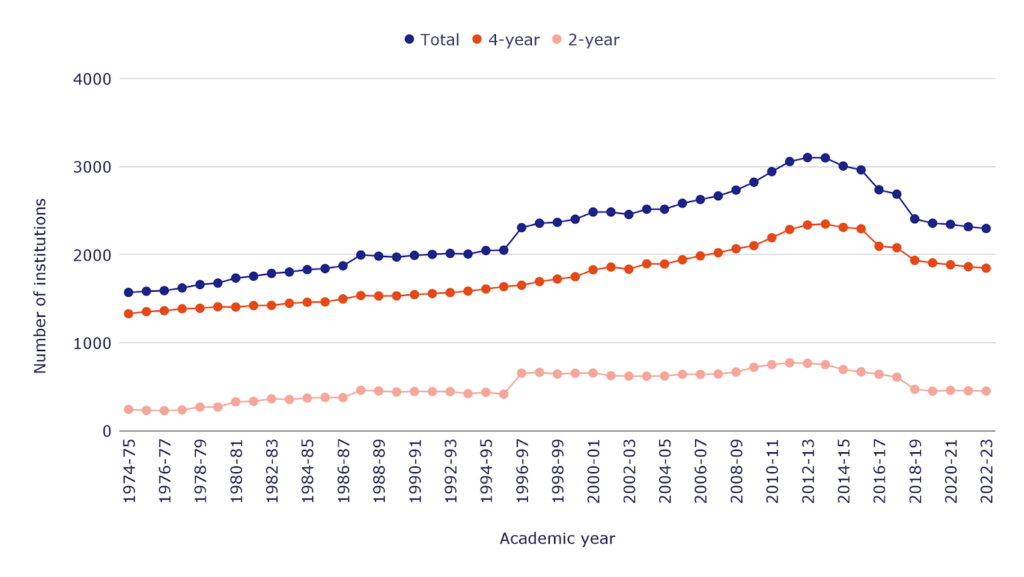
This dataset helps clarify how many private colleges in the U.S. exist and how the number of institutions has evolved over nearly five decades.
By separating 4-year and 2-year private institutions, the chart highlights long-term structural patterns relevant to understanding how many 4-year colleges are in the U.S., state-level capacity, and whether every state has a college.
How many private colleges are in the U.S.?
- The total number of private institutions increased from 1,571 in 1974-75 to a peak of 3,103 in 2012-13, before declining to 2,297 by 2022-23.
- Private 4-year colleges grew from 1,329 in 1974-75 to 2,348 in 2013-14, then gradually decreased to 1,846 in 2022-23.
- Private 2-year institutions rose from 242 in 1974-75 to a high of 771 in 2011-12, followed by a sharp contraction to 451 in 2022-23.
Growth and shifts in U.S. private higher education institutions
| Academic year | Total institutions | 4-year institutions | 2-year institutions |
| 1974-75 | 1,571 | 1,329 | 242 |
| 1975-76 | 1,584 | 1,353 | 231 |
| 1976-77 | 1,591 | 1,363 | 228 |
| 1977-78 | 1,622 | 1,386 | 236 |
| 1978-79 | 1,660 | 1,391 | 269 |
| 1979-80 | 1,677 | 1,408 | 269 |
| 1980-81 | 1,734 | 1,405 | 329 |
| 1981-82 | 1,755 | 1,421 | 334 |
| 1982-83 | 1,787 | 1,424 | 363 |
| 1983-84 | 1,803 | 1,448 | 355 |
| 1984-85 | 1,830 | 1,459 | 371 |
| 1985-86 | 1,842 | 1,463 | 379 |
| 1986-87 | 1,873 | 1,497 | 376 |
| 1987-88 | 1,996 | 1,536 | 460 |
| 1988-89 | 1,983 | 1,531 | 452 |
| 1989-90 | 1,972 | 1,532 | 440 |
| 1990-91 | 1,992 | 1,546 | 446 |
| 1991-92 | 2,003 | 1,558 | 445 |
| 1992-93 | 2,014 | 1,569 | 445 |
| 1993-94 | 2,007 | 1,586 | 421 |
| 1994-95 | 2,047 | 1,610 | 437 |
| 1995-96 | 2,051 | 1,636 | 415 |
| 1996-97 | 2,307 | 1,653 | 654 |
| 1997-98 | 2,357 | 1,694 | 663 |
| 1998-99 | 2,367 | 1,723 | 644 |
| 1999-2000 | 2,402 | 1,749 | 653 |
| 2000-01 | 2,484 | 1,828 | 656 |
| 2001-02 | 2,484 | 1,859 | 625 |
| 2002-03 | 2,456 | 1,835 | 621 |
| 2003-04 | 2,516 | 1,896 | 620 |
| 2004-05 | 2,516 | 1,894 | 622 |
| 2005-06 | 2,583 | 1,942 | 641 |
| 2006-07 | 2,626 | 1,986 | 640 |
| 2007-08 | 2,667 | 2,022 | 645 |
| 2008-09 | 2,733 | 2,067 | 666 |
| 2009-10 | 2,823 | 2,102 | 721 |
| 2010-11 | 2,943 | 2,192 | 751 |
| 2011-12 | 3,057 | 2,286 | 771 |
| 2012-13 | 3,103 | 2,337 | 766 |
| 2013-14 | 3,099 | 2,348 | 751 |
| 2014-15 | 3,006 | 2,310 | 696 |
| 2015-16 | 2,963 | 2,294 | 669 |
| 2016-17 | 2,737 | 2,095 | 642 |
| 2017-18 | 2,687 | 2,078 | 609 |
| 2018-19 | 2,406 | 1,935 | 471 |
| 2019-20 | 2,357 | 1,907 | 450 |
| 2020-21 | 2,344 | 1,885 | 459 |
| 2021-22 | 2,317 | 1,863 | 454 |
| 2022-23 | 2,297 | 1,846 | 451 |
Overall, private higher education experienced robust expansion through the late 20th century and early 2000s, driven by growth in both 4-year and 2-year institutions. However, after 2012-13, the sector underwent significant consolidation, with declines in both categories, especially 2-year colleges. These shifts shape state-level distributions, influencing which state has the most colleges, how many colleges are in each state, and the balance of private vs. public options nationwide.
Following the trends in private colleges overall, the next step is to examine how nonprofit institutions have changed over time.
Long-term trends in nonprofit colleges and universities
By differentiating 4-year and 2-year nonprofit institutions, the chart highlights long-term structural adjustments that shape the higher education landscape.
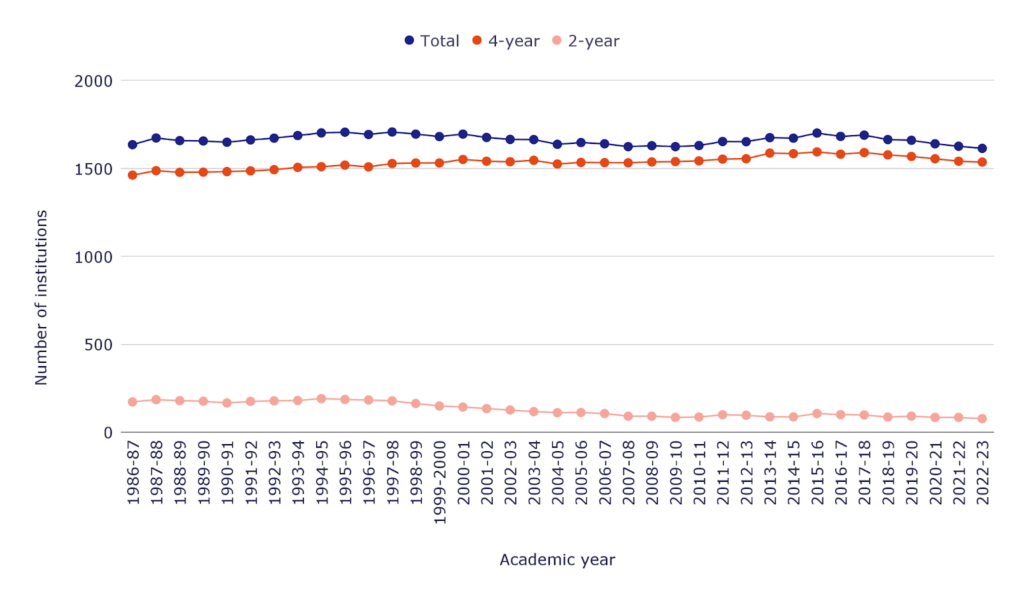
- The total number of nonprofit institutions increased from 1,635 in 1986-87 to a peak of 1,701 in 2015-16, before falling to 1,614 by 2022-23.
- Nonprofit 4-year colleges grew from 1,462 in 1986-87 to 1,594 in 2015-16, with a slight decline to 1,536 in 2022-23.
- Nonprofit 2-year institutions dropped sharply from 173 in 1986-87 to 78 in 2022-23, marking the most significant contraction within the sector.
Dynamics of U.S. nonprofit higher education institutions
| Academic year | Total institutions | 4-year institutions | 2-year institutions |
| 1986-87 | 1,635 | 1,462 | 173 |
| 1987-88 | 1,673 | 1,487 | 186 |
| 1988-89 | 1,658 | 1,478 | 180 |
| 1989-90 | 1,656 | 1,479 | 177 |
| 1990-91 | 1,649 | 1,482 | 167 |
| 1991-92 | 1,662 | 1,486 | 176 |
| 1992-93 | 1,672 | 1,493 | 179 |
| 1993-94 | 1,687 | 1,506 | 181 |
| 1994-95 | 1,702 | 1,510 | 192 |
| 1995-96 | 1,706 | 1,519 | 187 |
| 1996-97 | 1,693 | 1,509 | 184 |
| 1997-98 | 1,707 | 1,528 | 179 |
| 1998-99 | 1,695 | 1,531 | 164 |
| 1999-2000 | 1,681 | 1,531 | 150 |
| 2000-01 | 1,695 | 1,551 | 144 |
| 2001-02 | 1,676 | 1,541 | 135 |
| 2002-03 | 1,665 | 1,538 | 127 |
| 2003-04 | 1,664 | 1,546 | 118 |
| 2004-05 | 1,637 | 1,525 | 112 |
| 2005-06 | 1,647 | 1,534 | 113 |
| 2006-07 | 1,640 | 1,533 | 107 |
| 2007-08 | 1,624 | 1,532 | 92 |
| 2008-09 | 1,629 | 1,537 | 92 |
| 2009-10 | 1,624 | 1,539 | 85 |
| 2010-11 | 1,630 | 1,543 | 87 |
| 2011-12 | 1,653 | 1,553 | 100 |
| 2012-13 | 1,652 | 1,555 | 97 |
| 2013-14 | 1,675 | 1,587 | 88 |
| 2014-15 | 1,672 | 1,584 | 88 |
| 2015-16 | 1,701 | 1,594 | 107 |
| 2016-17 | 1,682 | 1,581 | 101 |
| 2017-18 | 1,689 | 1,590 | 99 |
| 2018-19 | 1,664 | 1,577 | 87 |
| 2019-20 | 1,660 | 1,568 | 92 |
| 2020-21 | 1,640 | 1,555 | 85 |
| 2021-22 | 1,626 | 1,541 | 85 |
| 2022-23 | 1,614 | 1,536 | 78 |
Overall, nonprofit higher education remained relatively stable over the past three decades, with modest growth in 4-year institutions offset by a significant decline in 2-year colleges. These long-term trends show gradual consolidation, with the most notable changes occurring among 2-year institutions.
After reviewing nonprofit institutions, the next step is to look at how for-profit colleges and universities have shifted over time.
Growth and decline of for-profit colleges and universities
The for-profit sector shows the most pronounced structural changes in U.S. higher education. Because for-profit schools expanded rapidly and then contracted just as quickly, this dataset helps explain fluctuations in the mix of institutions available to students and long-term changes in the U.S. higher education landscape.
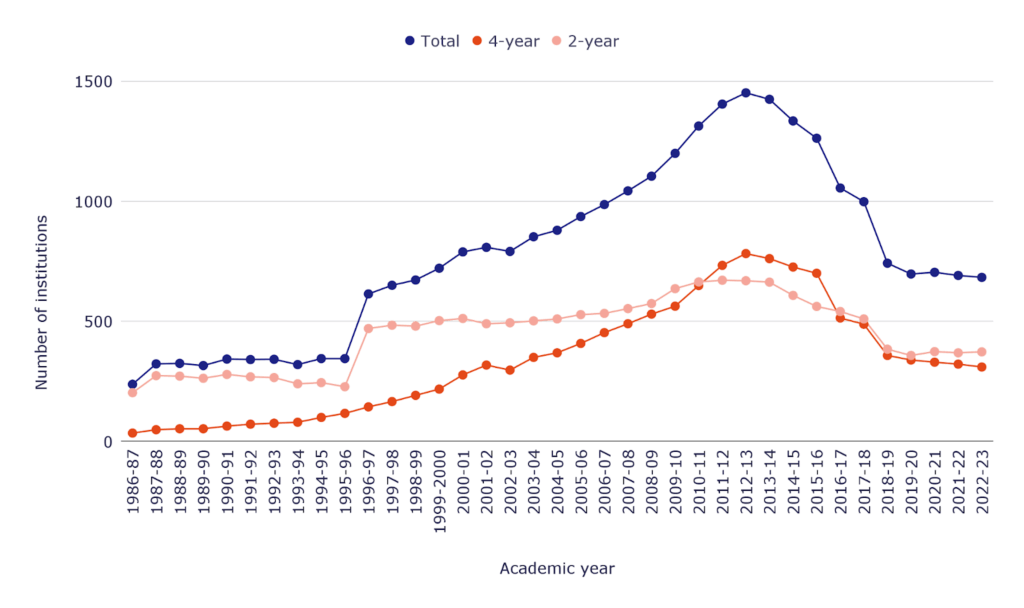
- The total number of for-profit institutions surged from 238 in 1986-87 to a peak of 1,451 in 2012-13, before dropping sharply to 683 by 2022-23.
- For-profit 4-year colleges grew from just 35 in 1986-87 to 782 at their peak in 2012-13, then fell to 310 in 2022-23.
- For-profit 2-year institutions rose from 203 in 1986-87 to 674 in 2011-12, but declined to 373 by 2022-23, marking a long-term contraction after years of rapid expansion.
Dynamics of U.S. for-profit higher education institutions
| Academic year | Total institutions | 4-year institutions | 2-year institutions |
| 1986-87 | 238 | 35 | 203 |
| 1987-88 | 323 | 49 | 274 |
| 1988-89 | 325 | 53 | 272 |
| 1989-90 | 316 | 53 | 263 |
| 1990-91 | 343 | 64 | 279 |
| 1991-92 | 341 | 72 | 269 |
| 1992-93 | 342 | 76 | 266 |
| 1993-94 | 320 | 80 | 240 |
| 1994-95 | 345 | 100 | 245 |
| 1995-96 | 345 | 117 | 228 |
| 1996-97 | 614 | 144 | 470 |
| 1997-98 | 650 | 166 | 484 |
| 1998-99 | 672 | 192 | 480 |
| 1999-2000 | 721 | 218 | 503 |
| 2000-01 | 789 | 277 | 512 |
| 2001-02 | 808 | 318 | 490 |
| 2002-03 | 791 | 297 | 494 |
| 2003-04 | 852 | 350 | 502 |
| 2004-05 | 879 | 369 | 510 |
| 2005-06 | 936 | 408 | 528 |
| 2006-07 | 986 | 453 | 533 |
| 2007-08 | 1,043 | 490 | 553 |
| 2008-09 | 1,104 | 530 | 574 |
| 2009-10 | 1,199 | 563 | 636 |
| 2010-11 | 1,313 | 649 | 664 |
| 2011-12 | 1,404 | 733 | 671 |
| 2012-13 | 1,451 | 782 | 669 |
| 2013-14 | 1,424 | 761 | 663 |
| 2014-15 | 1,334 | 726 | 608 |
| 2015-16 | 1,262 | 700 | 562 |
| 2016-17 | 1,055 | 514 | 541 |
| 2017-18 | 998 | 488 | 510 |
| 2018-19 | 742 | 358 | 384 |
| 2019-20 | 697 | 339 | 358 |
| 2020-21 | 704 | 330 | 374 |
| 2021-22 | 691 | 322 | 369 |
| 2022-23 | 683 | 310 | 373 |
The for-profit higher education sector experienced rapid growth from the late 1980s through the early 2010s, largely driven by the expansion of vocational programs and online learning providers. However, regulatory changes, accreditation pressures, and rising scrutiny led to a significant decline afterward.
After examining long-term institutional trends, it’s also important to understand how these patterns translate into the current landscape of colleges and universities across individual states.
Total number of colleges and universities by state
The 2022-23 dataset provides a clear snapshot of how many colleges are in each state, helping answer key questions such as which state has the most colleges and the overall number of universities by state.
What state has the most colleges and universities?
- California leads the nation with 403 colleges and universities. The total (403) includes public, private nonprofit, and private for-profit institutions combined.
- New York ranks second with 286 institutions, while Texas follows with 224, showing strong concentration in the largest states.
- The states with the fewest institutions include Delaware (7), Alaska (8), and Wyoming (9).
State distribution of U.S. colleges and universities in 2022-23
| State | Number of institutions |
| Alabama | 59 |
| Alaska | 8 |
| Arizona | 63 |
| Arkansas | 52 |
| California | 403 |
| Colorado | 59 |
| Connecticut | 37 |
| Delaware | 7 |
| District of Columbia | 18 |
| Florida | 158 |
| Georgia | 105 |
| Hawaii | 17 |
| Idaho | 13 |
| Illinois | 148 |
| Indiana | 64 |
| Iowa | 55 |
| Kansas | 61 |
| Kentucky | 57 |
| Louisiana | 50 |
| Maine | 29 |
| Maryland | 50 |
| Massachusetts | 104 |
| Michigan | 86 |
| Minnesota | 78 |
| Mississippi | 33 |
| Missouri | 88 |
| Montana | 23 |
| Nebraska | 33 |
| Nevada | 21 |
| New Hampshire | 24 |
| New Jersey | 80 |
| New Mexico | 36 |
| New York | 286 |
| North Carolina | 133 |
| North Dakota | 20 |
| Ohio | 156 |
| Oklahoma | 46 |
| Oregon | 47 |
| Pennsylvania | 178 |
| Rhode Island | 14 |
| South Carolina | 65 |
| South Dakota | 21 |
| Tennessee | 82 |
| Texas | 224 |
| Utah | 22 |
| Vermont | 16 |
| Virginia | 100 |
| Washington | 72 |
| West Virginia | 41 |
| Wisconsin | 66 |
| Wyoming | 9 |
State-level differences in higher education density are substantial, with the largest states hosting several hundred institutions while smaller states may have fewer than ten. These disparities affect national counts and help explain broader metrics such as the number of colleges by state and the current distribution of U.S. higher education capacity.
After reviewing the overall number of institutions by state, the next step is to look specifically at public colleges and universities, which form the core of each state’s publicly funded higher education system.
Total number of public colleges and universities by state
Public institutions include both public 4-year universities and public 2-year community or technical colleges. The 2022-23 dataset shows how these publicly funded campuses are distributed across the country. This breakdown highlights the central role public systems play in providing accessible and affordable higher education.
- California has the largest public system with 151 public institutions, followed by Texas with 102, making them the two biggest providers of public higher education in the nation.
- Several mid-sized states also have large public networks: New York (79), North Carolina (75), and Illinois (60).
- States with minimal public infrastructure include the District of Columbia (1), Rhode Island and Delaware (3), Alaska (4), Vermont (5), and Nevada (7), reflecting very small-scale public systems.
State distribution of public higher education institutions in 2022-23
| State | Number of institutions |
| Alabama | 37 |
| Alaska | 4 |
| Arizona | 25 |
| Arkansas | 34 |
| California | 151 |
| Colorado | 28 |
| Connecticut | 18 |
| Delaware | 3 |
| District of Columbia | 1 |
| Florida | 41 |
| Georgia | 50 |
| Hawaii | 10 |
| Idaho | 8 |
| Illinois | 60 |
| Indiana | 16 |
| Iowa | 19 |
| Kansas | 33 |
| Kentucky | 24 |
| Louisiana | 31 |
| Maine | 14 |
| Maryland | 29 |
| Massachusetts | 30 |
| Michigan | 46 |
| Minnesota | 40 |
| Mississippi | 23 |
| Missouri | 27 |
| Montana | 18 |
| Nebraska | 16 |
| Nevada | 7 |
| New Hampshire | 13 |
| New Jersey | 32 |
| New Mexico | 28 |
| New York | 79 |
| North Carolina | 75 |
| North Dakota | 14 |
| Ohio | 59 |
| Oklahoma | 30 |
| Oregon | 25 |
| Pennsylvania | 35 |
| Rhode Island | 3 |
| South Carolina | 33 |
| South Dakota | 13 |
| Tennessee | 24 |
| Texas | 102 |
| Utah | 8 |
| Vermont | 5 |
| Virginia | 40 |
| Washington | 42 |
| West Virginia | 22 |
| Wisconsin | 32 |
| Wyoming | 8 |
The distribution of public colleges and universities varies widely across states, largely reflecting population size, state funding models, and the historical development of public education systems.
States with larger or more decentralized public systems, such as California and Texas, operate extensive networks of community colleges and universities, while smaller or less populated states maintain far fewer campuses.
Understanding these differences helps contextualize the broader national picture of public vs. private institutions and the accessibility of publicly funded higher education across the U.S.
After outlining the total number of public institutions in each state, it’s useful to focus specifically on public 4-year colleges and universities, which serve as the primary providers of bachelor’s and graduate-level education.
Number of public 4-year colleges and universities by state
Public 4-year institutions represent the backbone of state-funded higher education, offering broad academic programs, research opportunities, and advanced degrees. The 2022-23 data highlights how these institutions are distributed across states.
- California and Texas lead the nation with 50 public 4-year institutions each, far outpacing all other states.
- New York (43), Florida (40), and Washington (36) also maintain large public university systems, reflecting significant statewide investment in higher education.
- States with the smallest number of public 4-year institutions include the District of Columbia (1) and Wyoming (1), while several states operate only 3–4 such institutions, such as Iowa and Delaware (3), Hawaii and Vermont (4).
State distribution of public 4-year institutions in 2022-23
| State | Number of institutions |
| Alabama | 14 |
| Alaska | 4 |
| Arizona | 5 |
| Arkansas | 12 |
| California | 50 |
| Colorado | 18 |
| Connecticut | 6 |
| Delaware | 3 |
| District of Columbia | 1 |
| Florida | 40 |
| Georgia | 27 |
| Hawaii | 4 |
| Idaho | 4 |
| Illinois | 12 |
| Indiana | 15 |
| Iowa | 3 |
| Kansas | 8 |
| Kentucky | 8 |
| Louisiana | 17 |
| Maine | 7 |
| Maryland | 13 |
| Massachusetts | 14 |
| Michigan | 22 |
| Minnesota | 13 |
| Mississippi | 8 |
| Missouri | 13 |
| Montana | 9 |
| Nebraska | 7 |
| Nevada | 7 |
| New Hampshire | 6 |
| New Jersey | 13 |
| New Mexico | 9 |
| New York | 43 |
| North Carolina | 17 |
| North Dakota | 9 |
| Ohio | 30 |
| Oklahoma | 17 |
| Oregon | 8 |
| Pennsylvania | 17 |
| Rhode Island | 2 |
| South Carolina | 13 |
| South Dakota | 9 |
| Tennessee | 11 |
| Texas | 50 |
| Utah | 7 |
| Vermont | 4 |
| Virginia | 16 |
| Washington | 36 |
| West Virginia | 13 |
| Wisconsin | 16 |
| Wyoming | 1 |
Large, highly populated states operate extensive public university networks, while smaller or less populated regions maintain far fewer campuses.
This variation underscores the importance of state-level policies and investments in shaping access to public higher education at the bachelor’s and graduate levels.
Following the overview of public 4-year institutions, it is important to examine public 2-year colleges, which provide accessible, affordable, and flexible options for students seeking associate degrees or transfer pathways.
Number of public 2-year colleges by state
Public 2-year institutions, including community and technical colleges, play a critical role in U.S. higher education by offering local access, workforce training, and opportunities to transfer to 4-year universities.
- California leads the nation with 101 public 2-year institutions, making it the state with the most community colleges.
- Texas (52) and North Carolina (58) also maintain extensive public 2-year networks, reflecting strong regional support for affordable postsecondary education.
- Several states, including Alaska, Delaware, the District of Columbia, and Nevada, have 0 public 2-year institutions, highlighting significant gaps in local access to community college education.
State distribution of public two-year institutions in 2022-23
| State | Number of institutions |
| Alabama | 23 |
| Alaska | 0 |
| Arizona | 20 |
| Arkansas | 22 |
| California | 101 |
| Colorado | 10 |
| Connecticut | 12 |
| Delaware | 0 |
| District of Columbia | 0 |
| Florida | 1 |
| Georgia | 23 |
| Hawaii | 6 |
| Idaho | 4 |
| Illinois | 48 |
| Indiana | 1 |
| Iowa | 16 |
| Kansas | 25 |
| Kentucky | 16 |
| Louisiana | 14 |
| Maine | 7 |
| Maryland | 16 |
| Massachusetts | 16 |
| Michigan | 24 |
| Minnesota | 27 |
| Mississippi | 15 |
| Missouri | 14 |
| Montana | 9 |
| Nebraska | 9 |
| Nevada | 0 |
| New Hampshire | 7 |
| New Jersey | 19 |
| New Mexico | 19 |
| New York | 36 |
| North Carolina | 58 |
| North Dakota | 5 |
| Ohio | 29 |
| Oklahoma | 13 |
| Oregon | 17 |
| Pennsylvania | 18 |
| Rhode Island | 1 |
| South Carolina | 20 |
| South Dakota | 4 |
| Tennessee | 13 |
| Texas | 52 |
| Utah | 1 |
| Vermont | 1 |
| Virginia | 24 |
| Washington | 6 |
| West Virginia | 9 |
| Wisconsin | 16 |
| Wyoming | 7 |
Public 2-year colleges are unevenly distributed across the United States, with some states operating extensive networks while others have none. This uneven distribution underscores the importance of state-level policies, population density, and funding in shaping access to affordable postsecondary education. Overall, public 2-year institutions provide critical opportunities for workforce development and educational mobility, complementing the nation’s network of public 4-year universities.
After analyzing public institutions, it’s important to explore private nonprofit colleges and universities, which provide a substantial portion of higher education opportunities across the U.S.
Number of private nonprofit colleges and universities by state
Private nonprofit institutions include liberal arts colleges, research universities, and specialized schools funded through tuition, endowments, and donations rather than state funding.
- New York has the highest number of private nonprofit institutions with 185 schools, followed by California (137) and Pennsylvania (110).
- Texas and Ohio both host significant networks of private nonprofit colleges, with 69 institutions each.
- Several states, including Wyoming (0), Nevada, Delaware, Alaska, and New Mexico (3), have very few private nonprofit colleges, highlighting regional disparities in access.
State distribution of private nonprofit institutions in 2022-23
| State | Number of institutions |
| Alabama | 18 |
| Alaska | 3 |
| Arizona | 10 |
| Arkansas | 17 |
| California | 137 |
| Colorado | 9 |
| Connecticut | 17 |
| Delaware | 3 |
| District of Columbia | 12 |
| Florida | 57 |
| Georgia | 36 |
| Hawaii | 4 |
| Idaho | 4 |
| Illinois | 74 |
| Indiana | 41 |
| Iowa | 33 |
| Kansas | 24 |
| Kentucky | 25 |
| Louisiana | 13 |
| Maine | 14 |
| Maryland | 18 |
| Massachusetts | 72 |
| Michigan | 38 |
| Minnesota | 33 |
| Mississippi | 9 |
| Missouri | 50 |
| Montana | 4 |
| Nebraska | 15 |
| Nevada | 3 |
| New Hampshire | 11 |
| New Jersey | 39 |
| New Mexico | 3 |
| New York | 185 |
| North Carolina | 49 |
| North Dakota | 5 |
| Ohio | 69 |
| Oklahoma | 14 |
| Oregon | 19 |
| Pennsylvania | 110 |
| Rhode Island | 11 |
| South Carolina | 24 |
| South Dakota | 6 |
| Tennessee | 42 |
| Texas | 69 |
| Utah | 5 |
| Vermont | 11 |
| Virginia | 40 |
| Washington | 23 |
| West Virginia | 9 |
| Wisconsin | 31 |
| Wyoming | 0 |
Private nonprofit colleges and universities are concentrated in large, highly populated states, providing extensive academic options and specialized programs. In contrast, smaller or less populous states often have very few private nonprofit institutions, reflecting limitations in local access. Overall, these institutions complement public colleges by offering diverse pathways for higher education, including specialized programs and liberal arts education, across the United States.
Following the overview of all private nonprofit institutions, we now focus specifically on 4-year private nonprofit colleges and universities, which grant bachelor’s degrees and often serve as research and liberal arts hubs.
Private nonprofit 4-year colleges and universities by state
Private nonprofit 4-year institutions are central to the U.S. higher education landscape, offering undergraduate programs, graduate degrees, and specialized fields of study.
- New York leads the nation with 167 private nonprofit 4-year institutions, followed by California (133) and Pennsylvania (101).
- Texas (64) and Ohio (65) maintain substantial networks of four-year nonprofit colleges.
- Several states, including Wyoming (0), Delaware, Alaska (2), Nevada, and New Mexico (3), have very limited access to private nonprofit 4-year institutions.
State distribution of private nonprofit 4-year institutions in 2022-23
| State | Number of institutions |
| Alabama | 17 |
| Alaska | 2 |
| Arizona | 9 |
| Arkansas | 14 |
| California | 133 |
| Colorado | 9 |
| Connecticut | 17 |
| Delaware | 2 |
| District of Columbia | 12 |
| Florida | 53 |
| Georgia | 33 |
| Hawaii | 4 |
| Idaho | 4 |
| Illinois | 72 |
| Indiana | 41 |
| Iowa | 33 |
| Kansas | 24 |
| Kentucky | 25 |
| Louisiana | 11 |
| Maine | 13 |
| Maryland | 18 |
| Massachusetts | 70 |
| Michigan | 38 |
| Minnesota | 32 |
| Mississippi | 9 |
| Missouri | 49 |
| Montana | 4 |
| Nebraska | 14 |
| Nevada | 3 |
| New Hampshire | 10 |
| New Jersey | 36 |
| New Mexico | 3 |
| New York | 167 |
| North Carolina | 48 |
| North Dakota | 5 |
| Ohio | 65 |
| Oklahoma | 13 |
| Oregon | 18 |
| Pennsylvania | 101 |
| Rhode Island | 11 |
| South Carolina | 23 |
| South Dakota | 6 |
| Tennessee | 39 |
| Texas | 64 |
| Utah | 4 |
| Vermont | 11 |
| Virginia | 38 |
| Washington | 21 |
| West Virginia | 9 |
| Wisconsin | 31 |
| Wyoming | 0 |
Private nonprofit 4-year colleges are highly concentrated in large and densely populated states, providing diverse academic programs and opportunities for undergraduate and graduate education. Smaller states or those with lower populations often have few such institutions, highlighting disparities in local access to four-year nonprofit education.
Overall, these colleges play a critical role in the U.S. higher education system by complementing public universities and supporting specialized academic and research programs.
After analyzing four-year private nonprofit colleges, it is also important to examine 2-year private nonprofit institutions, which primarily offer associate degrees and vocational programs.
Private nonprofit 2-year colleges and universities by state
Private nonprofit 2-year institutions represent a small but significant portion of U.S. higher education.
- New York dominates the 2-year nonprofit sector with 18 institutions, far exceeding all other states.
- Texas (5) and Pennsylvania (9) follow as the next most represented states for 2-year private nonprofit colleges.
- Many states, including Wyoming, Rhode Island, Nevada, and Montana, have 0 private nonprofit 2-year institutions, showing limited availability.
State distribution of private nonprofit 2-year institutions in 2022-23
| State | Number of institutions |
| Alabama | 1 |
| Alaska | 1 |
| Arizona | 1 |
| Arkansas | 3 |
| California | 4 |
| Colorado | 0 |
| Connecticut | 0 |
| Delaware | 1 |
| District of Columbia | 0 |
| Florida | 4 |
| Georgia | 3 |
| Hawaii | 0 |
| Idaho | 0 |
| Illinois | 2 |
| Indiana | 0 |
| Iowa | 0 |
| Kansas | 0 |
| Kentucky | 0 |
| Louisiana | 2 |
| Maine | 1 |
| Maryland | 0 |
| Massachusetts | 2 |
| Michigan | 0 |
| Minnesota | 1 |
| Mississippi | 0 |
| Missouri | 1 |
| Montana | 0 |
| Nebraska | 1 |
| Nevada | 0 |
| New Hampshire | 1 |
| New Jersey | 3 |
| New Mexico | 0 |
| New York | 18 |
| North Carolina | 1 |
| North Dakota | 0 |
| Ohio | 4 |
| Oklahoma | 1 |
| Oregon | 1 |
| Pennsylvania | 9 |
| Rhode Island | 0 |
| South Carolina | 1 |
| South Dakota | 0 |
| Tennessee | 3 |
| Texas | 5 |
| Utah | 1 |
| Vermont | 0 |
| Virginia | 2 |
| Washington | 2 |
| West Virginia | 0 |
| Wisconsin | 0 |
| Wyoming | 0 |
Private nonprofit 2-year colleges are far less common than their four-year counterparts and are concentrated in a few key states. Most states either have very few or no such institutions, indicating limited options for students seeking short-term, nonprofit-focused programs.
Overall, these colleges complement the larger higher education ecosystem by offering vocational training and associate degrees in regions where four-year institutions may be less accessible.
Having examined private nonprofit institutions, we now turn to private for-profit colleges and universities, which operate as businesses and often focus on career-oriented programs.
Private for-profit colleges and universities by state
Private for-profit institutions play a distinct role in U.S. higher education, catering primarily to students seeking flexible schedules and vocational programs.
- California leads the country with 115 private for-profit institutions, making it the largest hub for these colleges.
- Florida (60) and Texas (53) follow closely, showing strong regional clusters in the Sunbelt.
- Several states, including New Hampshire, Rhode Island, and Vermont, have 0 private for-profit colleges, indicating minimal presence.
State-level distribution of private for-profit institutions in 2022-23
| State | Number of institutions |
| Alabama | 4 |
| Alaska | 1 |
| Arizona | 28 |
| Arkansas | 1 |
| California | 115 |
| Colorado | 22 |
| Connecticut | 2 |
| Delaware | 1 |
| District of Columbia | 5 |
| Florida | 60 |
| Georgia | 19 |
| Hawaii | 3 |
| Idaho | 1 |
| Illinois | 14 |
| Indiana | 7 |
| Iowa | 3 |
| Kansas | 4 |
| Kentucky | 8 |
| Louisiana | 6 |
| Maine | 1 |
| Maryland | 3 |
| Massachusetts | 2 |
| Michigan | 2 |
| Minnesota | 5 |
| Mississippi | 1 |
| Missouri | 11 |
| Montana | 1 |
| Nebraska | 2 |
| Nevada | 11 |
| New Hampshire | 0 |
| New Jersey | 9 |
| New Mexico | 5 |
| New York | 22 |
| North Carolina | 9 |
| North Dakota | 1 |
| Ohio | 28 |
| Oklahoma | 2 |
| Oregon | 3 |
| Pennsylvania | 33 |
| Rhode Island | 0 |
| South Carolina | 8 |
| South Dakota | 2 |
| Tennessee | 16 |
| Texas | 53 |
| Utah | 9 |
| Vermont | 0 |
| Virginia | 20 |
| Washington | 7 |
| West Virginia | 10 |
| Wisconsin | 3 |
| Wyoming | 1 |
Private for-profit colleges are concentrated in a few states, with California, Florida, and Texas hosting the majority. Many smaller states have either very few or no institutions, highlighting uneven access for students pursuing career-oriented programs in certain regions.
Overall, these colleges complement public and nonprofit institutions by offering specialized, flexible educational options, often focused on immediate workforce entry.
Focusing now on 4-year private for-profit institutions, we can see which states offer these degree-granting programs at a bachelor’s level.
Private for-profit 4-year colleges by state
While many private for-profit colleges operate as 2-year institutions, a notable portion provide full 4-year degrees.
- California hosts the most 4-year private for-profit colleges, with 67 institutions.
- Texas (21) and Florida (29) also have significant numbers, forming the largest regional clusters.
- Several states, including Alaska, Montana, Rhode Island, Vermont, and Wyoming, have 0 institutions, indicating no 4-year private for-profit presence.
Distribution of 4-year private for-profit institutions across U.S. states
| State | Number of institutions |
| Alabama | 3 |
| Alaska | 0 |
| Arizona | 15 |
| Arkansas | 1 |
| California | 67 |
| Colorado | 9 |
| Connecticut | 2 |
| Delaware | 1 |
| District of Columbia | 3 |
| Florida | 29 |
| Georgia | 8 |
| Hawaii | 2 |
| Idaho | 0 |
| Illinois | 8 |
| Indiana | 2 |
| Iowa | 2 |
| Kansas | 1 |
| Kentucky | 4 |
| Louisiana | 0 |
| Maine | 1 |
| Maryland | 1 |
| Massachusetts | 1 |
| Michigan | 1 |
| Minnesota | 5 |
| Mississippi | 1 |
| Missouri | 7 |
| Montana | 0 |
| Nebraska | 0 |
| Nevada | 5 |
| New Hampshire | 0 |
| New Jersey | 6 |
| New Mexico | 3 |
| New York | 11 |
| North Carolina | 6 |
| North Dakota | 1 |
| Ohio | 8 |
| Oklahoma | 1 |
| Oregon | 2 |
| Pennsylvania | 4 |
| Rhode Island | 0 |
| South Carolina | 3 |
| South Dakota | 2 |
| Tennessee | 9 |
| Texas | 21 |
| Utah | 8 |
| Vermont | 0 |
| Virginia | 10 |
| Washington | 4 |
| West Virginia | 4 |
| Wisconsin | 2 |
| Wyoming | 0 |
4-year private for-profit colleges are concentrated in a handful of states, with the majority located in California, Florida, and Texas. Many states have very few or none, reflecting uneven access to degree-level for-profit education. These institutions complement the broader higher education ecosystem by offering alternatives for students seeking career-focused 4-year programs outside public or nonprofit systems.
Shifting focus from 4-year programs, the following data illustrates the landscape of private for-profit 2-year institutions across the U.S.
Private for-profit 2-year colleges by state
Private for-profit 2-year colleges primarily offer associate degrees and vocational training.
- California leads in private for-profit 2-year institutions with 48 colleges, followed closely by Texas (32) and Florida (31).
- Pennsylvania hosts 29 institutions, making it another notable state for 2-year private for-profit options.
- Several states, including Arkansas, Connecticut, Delaware, Maine, Minnesota, North Dakota, Rhode Island, and Vermont, have 0 institutions, showing no presence of 2-year private for-profit colleges.
Distribution of 2-year private for-profit institutions across U.S. states
| State | Number of institutions |
| Alabama | 1 |
| Alaska | 1 |
| Arizona | 13 |
| Arkansas | 0 |
| California | 48 |
| Colorado | 13 |
| Connecticut | 0 |
| Delaware | 0 |
| District of Columbia | 2 |
| Florida | 31 |
| Georgia | 11 |
| Hawaii | 1 |
| Idaho | 1 |
| Illinois | 6 |
| Indiana | 5 |
| Iowa | 1 |
| Kansas | 3 |
| Kentucky | 4 |
| Louisiana | 6 |
| Maine | 0 |
| Maryland | 2 |
| Massachusetts | 1 |
| Michigan | 1 |
| Minnesota | 0 |
| Mississippi | 0 |
| Missouri | 4 |
| Montana | 1 |
| Nebraska | 2 |
| Nevada | 6 |
| New Hampshire | 0 |
| New Jersey | 3 |
| New Mexico | 2 |
| New York | 11 |
| North Carolina | 3 |
| North Dakota | 0 |
| Ohio | 20 |
| Oklahoma | 1 |
| Oregon | 1 |
| Pennsylvania | 29 |
| Rhode Island | 0 |
| South Carolina | 5 |
| South Dakota | 0 |
| Tennessee | 7 |
| Texas | 32 |
| Utah | 1 |
| Vermont | 0 |
| Virginia | 10 |
| Washington | 3 |
| West Virginia | 6 |
| Wisconsin | 1 |
| Wyoming | 1 |
Private for-profit 2-year institutions are heavily concentrated in a few large states, primarily California, Texas, and Florida, while many states lack any presence. These colleges provide an alternative pathway for career-focused education, particularly in regions with higher population density and demand for vocational training. The uneven distribution highlights both opportunities and gaps in access to short-term, career-oriented higher education across the United States.
After exploring higher education, it is important to examine the foundation of the U.S. education system: K-12 schools, which serve millions of students nationwide.
An overview of K-12 schools across the U.S.
K-12 schools in the U.S.: total numbers and breakdown
The K-12 school system in the U.S. includes prekindergarten, elementary, middle, and secondary or high schools. From 2012-13 to 2022-23, the total number of institutions remained fairly stable, hovering around 98,000-99,000 schools.
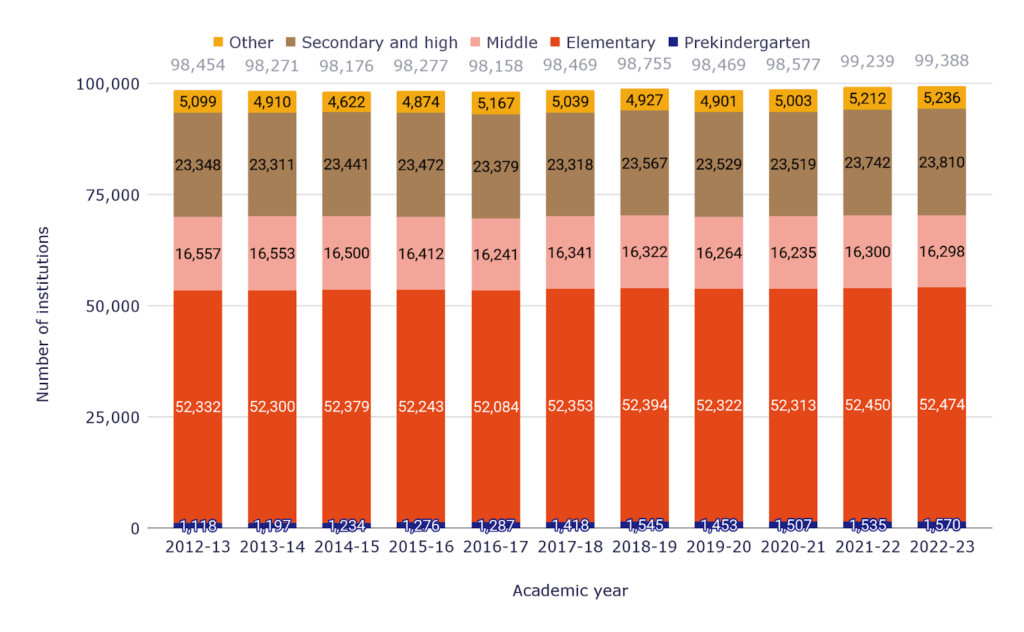
- Elementary schools remained the largest segment with 52,474 institutions in 2022-23, showing minimal change over the decade.
How many schools are in the U.S.?
- Secondary and high schools totaled 23,810 in 2022-23, slightly increasing from 23,348 in 2012-13.
- Other types of schools, such as vocational or special education, numbered 5,236 in 2022-23, reflecting a small but consistent portion of total institutions.
Overview of K-12 education institutions across the United States
| Academic year | Institutions | |||||
| Prekindergarten | Elementary | Middle | Secondary and high | Other | Total | |
| 2012-13 | 1,118 | 52,332 | 16,557 | 23,348 | 5,099 | 98,454 |
| 2013-14 | 1,197 | 52,300 | 16,553 | 23,311 | 4,910 | 98,271 |
| 2014-15 | 1,234 | 52,379 | 16,500 | 23,441 | 4,622 | 98,176 |
| 2015-16 | 1,276 | 52,243 | 16,412 | 23,472 | 4,874 | 98,277 |
| 2016-17 | 1,287 | 52,084 | 16,241 | 23,379 | 5,167 | 98,158 |
| 2017-18 | 1,418 | 52,353 | 16,341 | 23,318 | 5,039 | 98,469 |
| 2018-19 | 1,545 | 52,394 | 16,322 | 23,567 | 4,927 | 98,755 |
| 2019-20 | 1,453 | 52,322 | 16,264 | 23,529 | 4,901 | 98,469 |
| 2020-21 | 1,507 | 52,313 | 16,235 | 23,519 | 5,003 | 98,577 |
| 2021-22 | 1,535 | 52,450 | 16,300 | 23,742 | 5,212 | 99,239 |
| 2022-23 | 1,570 | 52,474 | 16,298 | 23,810 | 5,236 | 99,388 |
The K-12 school system in the U.S. demonstrates remarkable stability, with nearly 99,400 institutions in 2022-23. While prekindergarten and elementary schools make up the majority of institutions, secondary and high schools, along with other specialized schools, play a critical role in providing comprehensive education. Overall, the distribution highlights a well-established system capable of serving a large and diverse student population across multiple educational levels.
Having explored the number and types of higher education institutions, it is essential to examine enrollment metrics, which reveal how many students these institutions serve annually.
College enrollment trends and statistics
Enrollment trends in U.S. colleges and universities
Enrollment patterns in the U.S. differ significantly between public and private institutions.
From 1975 to 2023, the average enrollment per public institution grew steadily, reflecting the expanding role of public colleges and universities.
Meanwhile, private institutions maintained much smaller but more stable enrollment figures, highlighting differences in scale and capacity between public and private higher education.
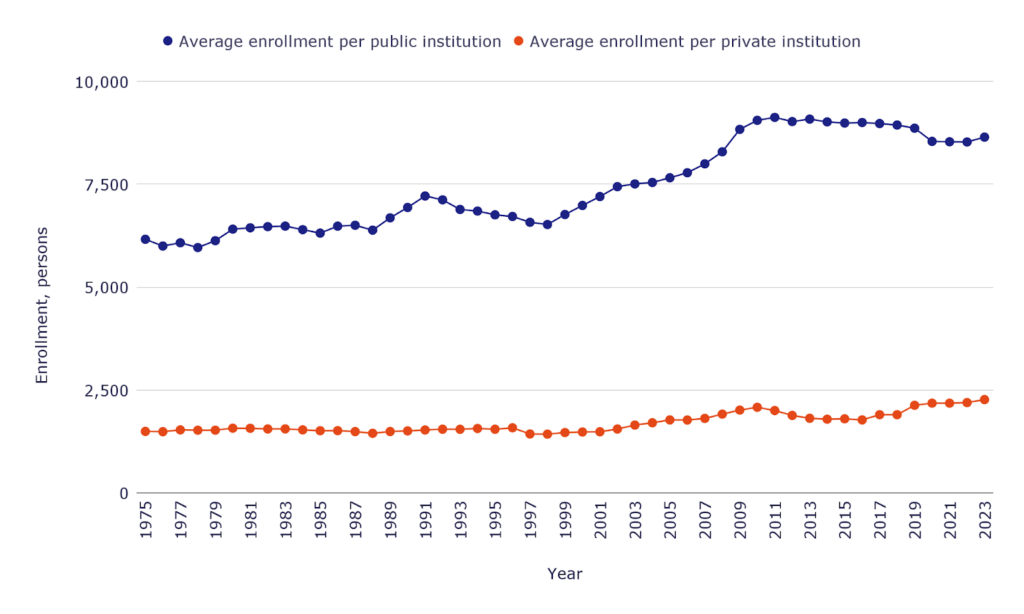
- Average enrollment per public institution reached 8,648 in 2023, up from 6,165 in 1975, indicating a long-term growth trend.
- Private institutions averaged 2,269 students in 2023, a notable increase from 1,496 in 1975.
- Public colleges consistently enroll about 3-4 times more students than private colleges, exemplifying the scale difference between the two sectors.
Average college enrollment by institution type
| Year | Average enrollment per public institution | Average enrollment per private institution |
| 1975 | 6,165 | 1,496 |
| 1976 | 6,001 | 1,489 |
| 1977 | 6,080 | 1,533 |
| 1978 | 5,965 | 1,525 |
| 1979 | 6,131 | 1,526 |
| 1980 | 6,412 | 1,574 |
| 1981 | 6,444 | 1,571 |
| 1982 | 6,473 | 1,555 |
| 1983 | 6,485 | 1,557 |
| 1984 | 6,399 | 1,533 |
| 1985 | 6,315 | 1,512 |
| 1986 | 6,485 | 1,514 |
| 1987 | 6,506 | 1,491 |
| 1988 | 6,387 | 1,450 |
| 1989 | 6,686 | 1,493 |
| 1990 | 6,938 | 1,508 |
| 1991 | 7,217 | 1,531 |
| 1992 | 7,124 | 1,549 |
| 1993 | 6,890 | 1,547 |
| 1994 | 6,851 | 1,567 |
| 1995 | 6,760 | 1,548 |
| 1996 | 6,719 | 1,583 |
| 1997 | 6,578 | 1,433 |
| 1998 | 6,525 | 1,429 |
| 1999 | 6,767 | 1,468 |
| 2000 | 6,987 | 1,482 |
| 2001 | 7,204 | 1,487 |
| 2002 | 7,444 | 1,554 |
| 2003 | 7,511 | 1,650 |
| 2004 | 7,547 | 1,706 |
| 2005 | 7,660 | 1,775 |
| 2006 | 7,782 | 1,773 |
| 2007 | 7,998 | 1,812 |
| 2008 | 8,291 | 1,916 |
| 2009 | 8,837 | 2,013 |
| 2010 | 9,056 | 2,082 |
| 2011 | 9,128 | 2,003 |
| 2012 | 9,026 | 1,884 |
| 2013 | 9,086 | 1,814 |
| 2014 | 9,018 | 1,792 |
| 2015 | 8,990 | 1,802 |
| 2016 | 9,004 | 1,776 |
| 2017 | 8,978 | 1,902 |
| 2018 | 8,942 | 1,903 |
| 2019 | 8,865 | 2,131 |
| 2020 | 8,544 | 2,182 |
| 2021 | 8,535 | 2,181 |
| 2022 | 8,531 | 2,196 |
| 2023 | 8,648 | 2,269 |
Over the last five decades, U.S. higher education has seen significant enrollment growth, especially in public institutions. This growth reflects both increased demand for higher education and the capacity of public colleges and universities to accommodate more students. Private institutions, while smaller in scale, have also experienced gradual growth, maintaining a critical role in offering diverse educational opportunities. Overall, enrollment metrics provide insight into how the U.S. education system balances accessibility, size, and institutional type to meet student needs.
After examining average enrollment trends, it is insightful to look at the largest universities in the U.S. by enrollment, which illustrate the scale of individual institutions.
Top 10 largest U.S. universities by undergraduate enrollment
Some universities in the United States serve tens of thousands of students, far exceeding the average enrollment figures discussed earlier. These institutions not only accommodate large student populations but also play a major role in shaping higher education accessibility across the country. The chart highlights the largest universities in the U.S. by enrollment, focusing on undergraduate populations in fall 2024.
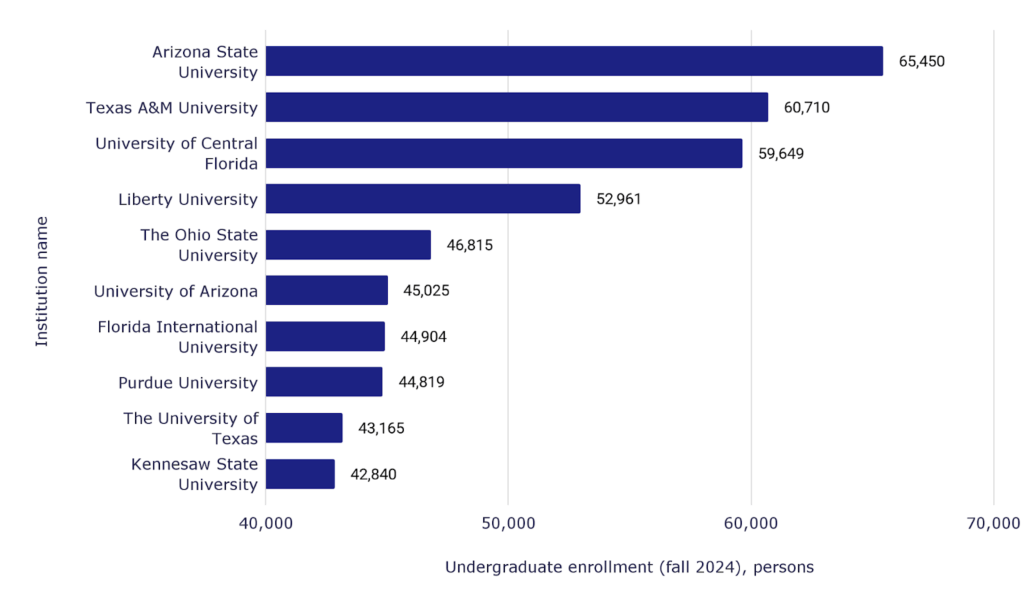
- Arizona State University tops the list with 65,450 undergraduates, making it the largest U.S. university by enrollment.
- Texas A&M University and the University of Central Florida follow closely, enrolling 60,710 and 59,649 students, respectively.
- Kennesaw State University rounds out the top 10 with 42,840 students, showing that even the 10th-largest institution serves a substantial student body.
Largest universities in the U.S. by enrollment: student numbers by institution
The largest U.S. universities have undergraduate enrollments ranging from roughly 43,000 to 65,000 students, far above the national average for both public and private institutions. These institutions demonstrate the scale and diversity of higher education in America, accommodating large student populations across multiple campuses and programs.
Understanding the largest universities by enrollment provides context for national trends, resource allocation, and the impact of high-capacity institutions on the higher education landscape.
Conclusions
U.S. higher education has undergone a measurable structural shift over the past decade, with the total number of colleges falling from a 2012 peak of 4,726 to 3,896 in 2022-23. This decline reflects long-term consolidation driven by demographic change, financial pressures, and the retrenchment of for-profit institutions.
Despite the overall contraction, public 4-year universities continue to expand, reaching a record 782 institutions, while 2-year colleges, both public and private, have experienced the steepest reductions. These diverging trends reshape access pathways, especially for students who rely on community colleges as entry points to higher education.
State-level disparities remain pronounced: California’s 403 institutions contrast sharply with states hosting fewer than ten, underscoring unequal regional capacity. Enrollment patterns also reinforce sectoral divides, with public institutions serving nearly four times more students per campus than private colleges.
Overall, the modern U.S. education landscape reflects consolidation, growth in large public systems, and reduced diversity in institutional types. These shifts signal a transition toward fewer but larger institutions, a rebalanced mix of public and private options, and a long-term restructuring of how higher education capacity is distributed across the nation.
Sources
- Degree-Granting Postsecondary Institutions, by Control and Classification of Institution and State or Jurisdiction: Academic Year 2022-23. https://nces.ed.gov/programs/digest/d23/tables/dt23_317.20.asp. Accessed 17 November 2025.
- Degree-Granting Postsecondary Institutions, by Control and Level of Institution: Selected Academic Years, 1949-50 through 2022-23. https://nces.ed.gov/programs/digest/d23/tables/dt23_317.10.asp. Accessed 17 November 2025.
- Degree-Granting Postsecondary Institutions That Have Closed, by Control and Level of Institution: Academic Years 1969-70 through 2022-23. https://nces.ed.gov/programs/digest/d23/tables/dt23_317.50.asp. Accessed 17 November 2025.
- Total Fall Enrollment in Degree-Granting Postsecondary Institutions, by Attendance Status, Sex of Student, and Control of Institution: Selected Years, 1947 through 2023. https://nces.ed.gov/programs/digest/d24/tables/dt24_303.10.asp. Accessed 17 November 2025.
- “Best National Universities Rankings.” US News. https://www.usnews.com/best-colleges/rankings/national-universities?myCollege=national-universities&_sort=enrollment&_sortDirection=desc&_mode=table. Accessed 17 November 2025.